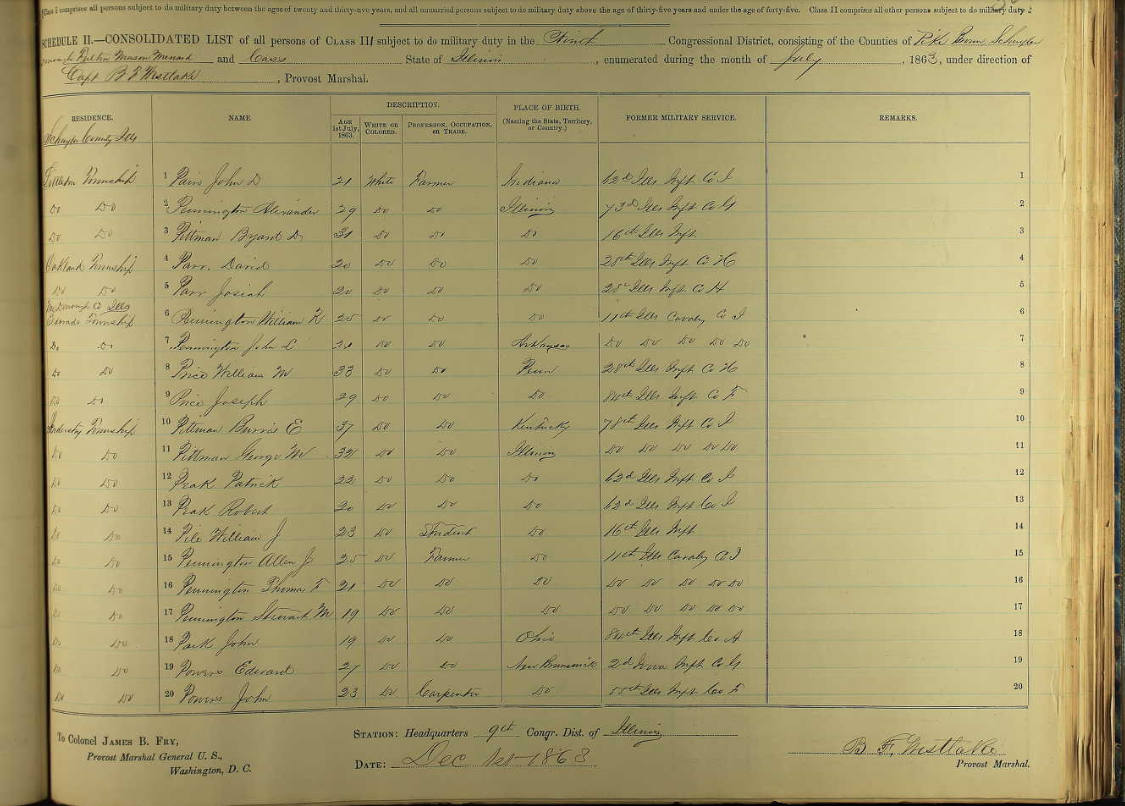
Burris Estridge Pittman was one of the approximately 2.1 million soldiers who served in the Union Army during the American Civil War. He held the rank of Private in Company I of the 78th Illinois Infantry, proudly fighting for the Union cause.
When he enlisted, Burris was recorded as being 5 feet 9 1/2 inches tall, with dark hair and brown eyes. His complexion was described as sandy. At the time of his enlistment, he was married to Julia E. Crisman and worked as a farmer.
Born on September 2, 1826, in Elktown, Todd County, Kentucky, Burris was 36 years old when he made the decision to join the Union Army on August 14, 1862. Notably, his age of 36 was older than the average age of 25 for those who served in the army during that period. Captain Reynolds enlisted him in Industry, Illinois, for a service commitment of three years.
Burris Pittman officially mustered into service on September 1, 1862, in Quincy, Illinois, marking the beginning of his service as a Union soldier during the challenging years of the Civil War.
Battle at Dover, Tennessee
The Battle at Dover, Tennessee, during the American Civil War involved the 78th Illinois Infantry and is described as follows:
In late January 1863, Confederate Maj. Gen. Joseph Wheeler received information suggesting that the Federal garrison at Dover, Tennessee, was relatively small and vulnerable. Acting on these reports, he made the decision to attack the garrison, which included the 78th Illinois Infantry.
The Confederate forces, led by Gen. Wheeler, embarked on their mission to Dover, also known as Fort Donelson. On February 3, between 1:00 and 2:00 p.m., they initiated their attack on the Federal garrison. The garrison, consisting of approximately 800 men under the command of Col. A.C. Harding, was strategically positioned in and around the town of Dover. They had carefully chosen camps that provided a commanding view of the area and had fortified their positions with rifle pits and battery emplacements.
The Confederate attackers displayed determination and skill, utilizing artillery fire in their assault. However, they suffered heavy losses and were ultimately repulsed by the well-defended Union forces. As the day progressed, both sides found themselves running low on ammunition. The Confederate forces evaluated the Union defenses and determined that capturing the position would be too challenging. Consequently, General Wheeler’s forces decided to withdraw, and the Federals attempted a pursuit but were unsuccessful.
Following this engagement, Burris Estridge Pittman was discharged from the Union Army on August 18, 1863, due to a disability, most likely an injury sustained during the Battle at Dover, Tennessee. His place of residence was noted as Industry, McDonough County, Illinois. This information is sourced from the Illinois Civil War Muster and Descriptive Rolls.

Burris Pittman was born on September 2, 1826, in Todd County, Kentucky, to his parents William and Nancy Wyatt Pittman. His parents hailed from North Carolina and Tennessee, respectively. Burris was the eldest of thirteen children born to William and Nancy Pittman. The Pittman family relocated to Morgan County, Illinois, in 1828, and in the autumn of 1836, they made another move to McDonough County, Illinois.
At the age of 21, Burris embarked on a new chapter in his life by marrying Julia Crisman. He also made a significant investment by purchasing a farm located two and a half miles south of Industry, Illinois.
In 1867, Burris decided to sell his farm and acquired another sizable property, totaling three hundred and thirty-one acres. This new farm, known as the David Jenkins farm and situated in Section 2 of Lamoine Township, was renowned locally as one of the finest stock farms in the state during that era. The farm’s advantageous location for stock purposes, complete with a large brick house, a spacious barn, numerous outbuildings, and even timber on the land, made it a prime choice. Burris raised horses, cattle, a substantial number of hogs, and maintained a flock of sheep on his farm. Additionally, its proximity to several stations on the Chicago, Burlington & Quincy Railroad facilitated easy shipping of goods.
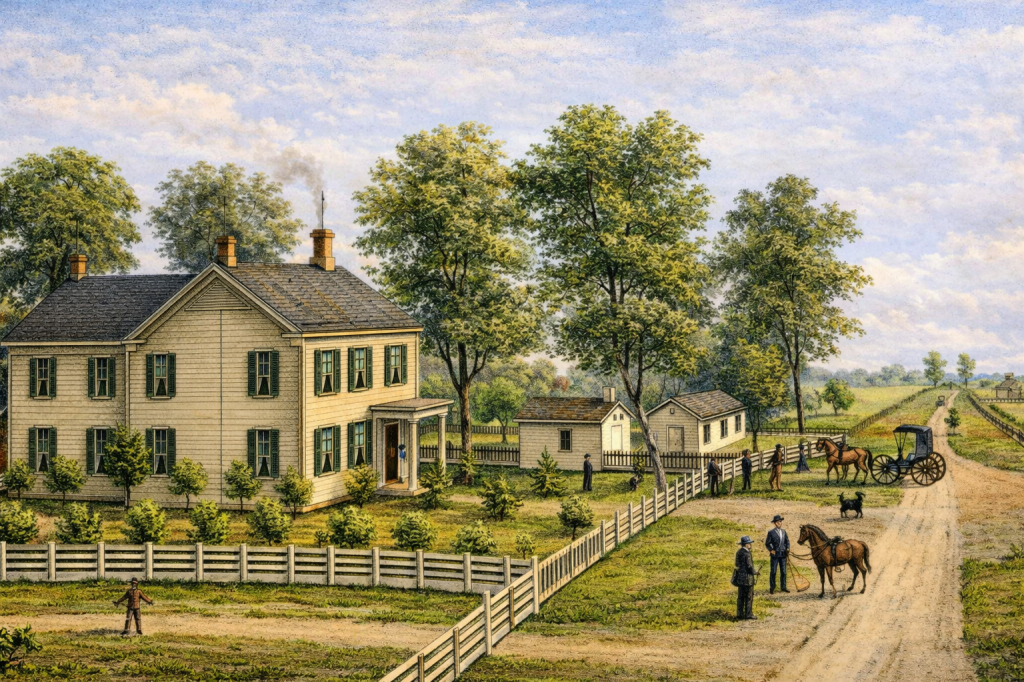
Home of Burris Pittman drawn by him in 1871.
Beyond his agricultural pursuits, Burris Pittman possessed natural artistic talents. He was known for his skill in drawing, particularly depicting homes and farms in McDonough County, Illinois. His artwork found its way into a book published about the people and history of the county.
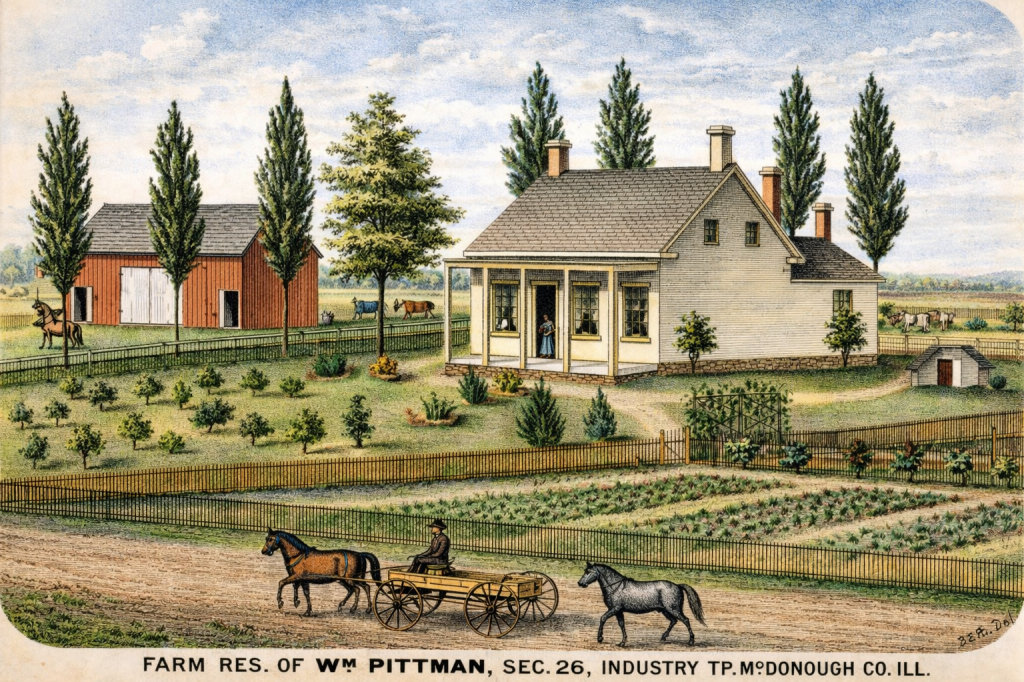
Home of William Pittman in Industry Township, Illinois where Burris grew up.
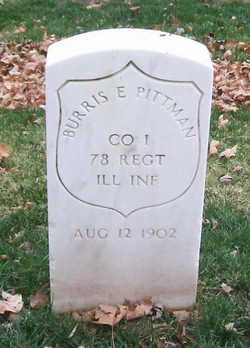
Burris owned a farm in Industry, Illinois. The 1860 U.S. Census listed the value of his farm at $4000 dollars and his personal property at $760 dollars. He was married to Julia Crisman and had two daughters Florence and Eugenia. He died on August 12, 1902 in Leavenworth, Kansas and is buried in the Leavenworth National Cemetery. Burris Pittman was the great uncle of Thelma Landis Farr.
 Farr's of Fulton County, Illinois