
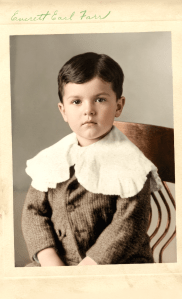
In 1908, nine year old Everett Farr walked out onto the stage at Camp Creek School, which was the front part of the classroom in the one room school, for his recitation of “A Lovely Scene”. Miss Bobbitt, Everett’s teacher had worked hard with the students to prepare a wonderful Thanksgiving School program for the parents. This was a big event for the children of Industry, Illinois. Two of Everett’s sisters were also in the program both were doing recitations, Bessie Farr did “The Freckle Face Girl” and Effie Farr recited “Miss Edith Helps Things Along”. The program had begun with everyone singing “My Country, ’Tis of Thee”. Everett enjoyed that. He looked out at the parents who had come to see the performance and saw his mother smiling. He took a breath and began reciting “A Lovely Scene”. He remembered all the words. When he was done the audience clapped and Everett gave a short bow.
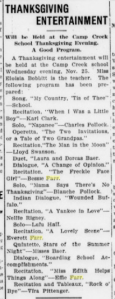
The Macomb Journal, 19 November 1908, pg. 1. Click on image to read.
Camp Creek School, situated near Industry, Illinois in McDonough County, was a single room school that served the children of Industry and Scotland townships from the 1830s into the twentieth century. Named after Camp Creek, a Mississippi River tributary flowing through the area, the school was located on the east side of Camp Creek Road, roughly a mile south of the village of Industry.
In 1903, W.T. Brookings reflected on his arrival in McDonough County in 1834 in an article for the Macomb Journal. He recalled “I landed in this country in October, 1834, eight of us in a wagon drawn by oxen. We stopped in a school house on Camp Creek, stayed in that for six weeks. The school house was used for preaching on Sundays every two weeks. Wild cats were around at night and sometimes would get on top of the house and squall to make it lively. This school house was situated near Camp Creek cemetery.” (The Macomb Journal, 17 Dec 1903, p. 10)
Camp Creek School served students from kindergarten through eighth grade, covering subjects such as reading, writing, arithmetic, history, and geography. Camp Creek School was a one-room school house. While we do not have complete records of all the teachers who taught at Camp Creek we do know some from various articles in the Macomb Journal and Macomb Daily By-stander newspapers. As was the custom, female teachers were not married.

Camp Creek Teachers – 1834 – Miss Mary Mead, 1897 Miss Louise Freeland, 1902 Miss Etta Knowles, 1903 Miss Laughlin, 1904 Miss Cora Spear, 1905 Mr. Charles White, 1906 Miss Bessie Gill, 1907-1909 Miss Eloisa Bobbitt, 1908 & 1909 Miss Beulah Legere, 1909 Miss Lena Leach, 1918-1920 Miss Fay Ervin.
Camp Creek schoolhouse was a simple wooden structure with one large classroom and a smaller cloakroom. The classroom was heated by a wood stove, and the students used kerosene lamps for light. The schoolhouse was also equipped with a bell tower, which was used to signal the start and end of the school day. Camp Creek School was originally equipped with a single outhouse for both boys and girls, but in the early 1900s, a separate outhouse was built for the girls.
Camp Creek School was a vital part of the Industry and Scotland communities. It was a place where children came to learn, but it was also a place where they gathered to socialize and play. The schoolhouse was also used for community events, such as church services, dances, and potluck dinners.
So what goes on at a rural school such as Camp Creek? We get a glimpse from the local newspapers. In 1901, a mail box was placed at Camp Creek School for use by the public. In May 1902, the superintendent was considering closing school early for summer because three people in Scotland Township came down with smallpox. There was a big thunder storm in May 1908, with lots of hard rain and hail. Lightning struck a stake that had been used in surveying, about fifty feet from Camp Creek school house, while school was in session. The Macomb Journal reported that the children were excited and maybe a little scared by the lightening strike but did not panic.
In February 1909, Camp Creek’s only teacher Miss Bobbitt threw the contents of a wastebasket into the wood burning stove in the classroom not realizing that there was a roll of paper banknotes amounting to $17 dollars that had fallen into the trash. Miss Bobbitt was able to get the money out before the fire consumed all of it. The newspaper reported that she hoped the government would replace the fragments with news bills.
In December of 1908, the students and teacher held a Box Supper and literary program at the school house. It was considered a good financial success with $25.65 in total receipts. The highest price paid for a box was $3 and a double box brought in $4.50. In March of 1908, the students had a Spelling Bee and they also sold peanuts and homemade candy to raise money for the school.
In the summer of 1908, a tree blew down at hit the school building but did no damage to the structure according to an article in the Macomb Journal. It was reported that Albert Swanson and Guy Walker were cutting down trees on the school grounds and removing those that were dead or dilapidated, or just too thick to improve the appearance of the school grounds. In October 1919, the newspaper reported that $1.50 was spent on a geography display for Camp Creek School. In November 1921, student Edith Swearingen was awarded a perfect attendance certificate, and in December of 1921, Mrs. Everett Hudson formerly Miss Faye Ervin who had taught at Camp Creek School for two years had a baby son.
Camp Creek Cemetery, which is located about a mile north of the former site of the school, is the final resting place of many of the people who attended and taught at Camp Creek School. The school no longer exists today.
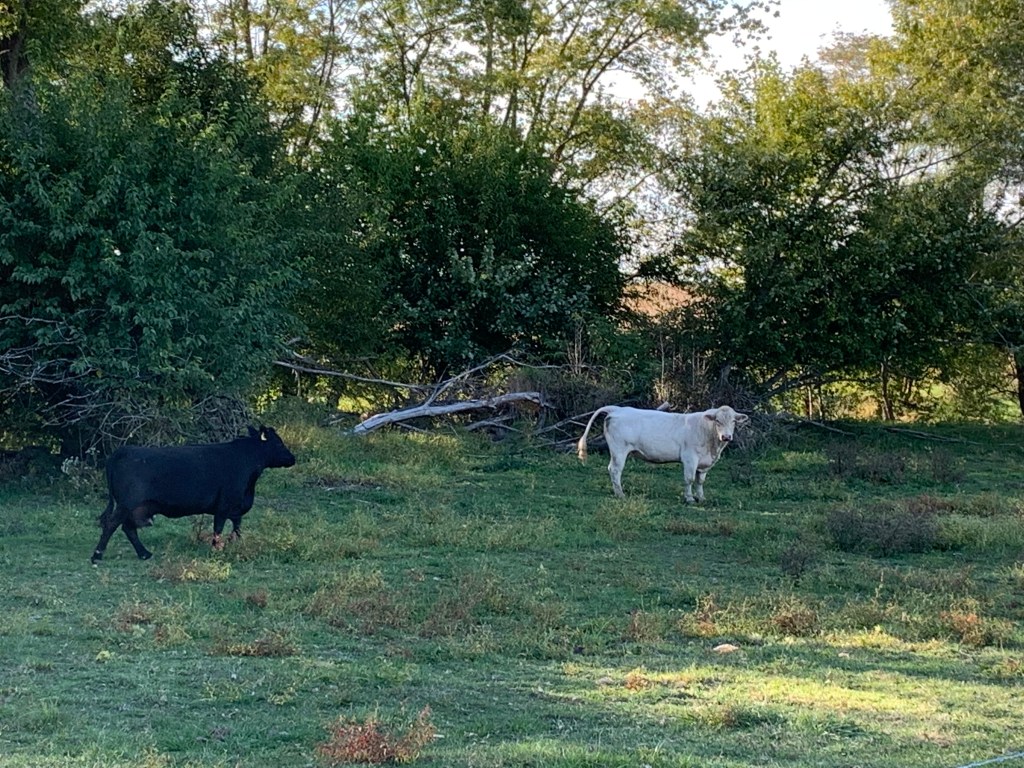
Site of Camp Creek School in 2022, McDonough County, Illinois
 Farr's of Fulton County, Illinois
Who ever posted this…..we are related. My search revealed that John Taylor Farris an ancestor. I believe he was married to Eva Farr….my grandmothers mother. My grandmothers name was Louella Farr.
LikeLike
Yes, we are related. John Taylor Farr was the brother of Samuel Farr who was my great, great grandfather. John Farr would be my great, great granduncle. I have a section about John T. Farr on this website. Do you have any old pictures of your grandmother or great grandparents? Thanks, John Farr
LikeLike
I’m sorry that I have no old pictures that go further back than my grandmother Louella Farr Anderson. Her last name prior to her passing was Steffler. I am trying to find ore his Tory on her first husband Whose name was supposedly Oscar Ferdinand Anderson. You have done a good job with the genealogy.
LikeLike
John’s son Ray Farr was my Grandpa Philip Farr’s dad.
LikeLike