Teacher in Jackson Township, Ohio
Early Life and Marriage
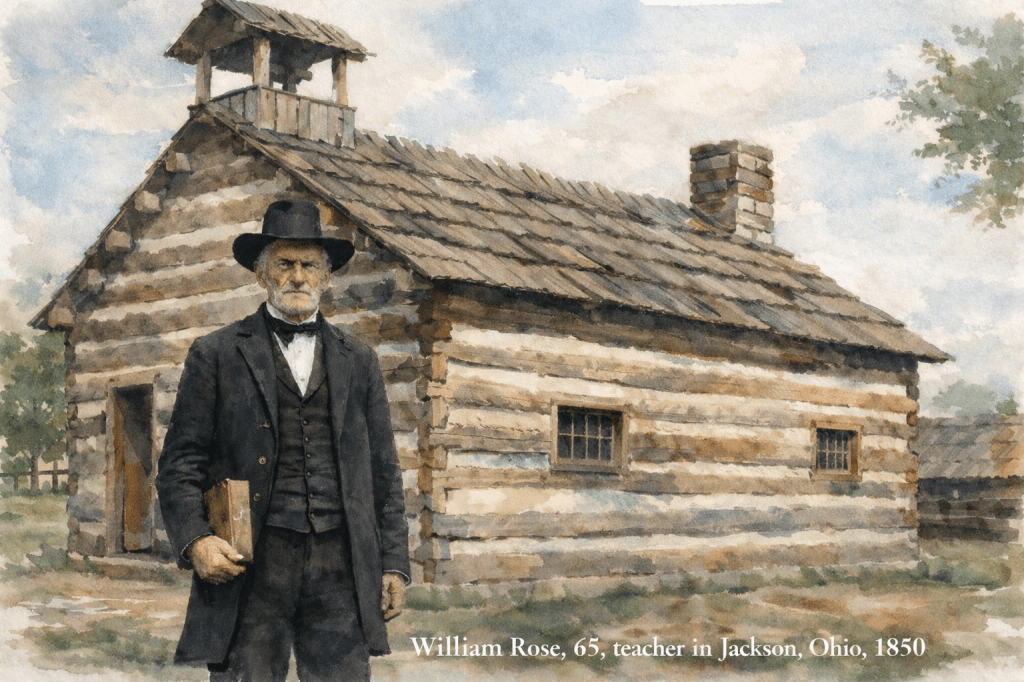
William Rose was born on July 2, 1785, in Prince William County, Virginia, where he spent his early years. On April 19, 1808, he married Susannah Dollard in Bedford, Virginia. William learned to read and write well and received some formal education, though the extent of his schooling and the identity of his instructors remain unknown. To our knowledge William Rose was the first teacher in the Farr Family. He was the third great-grandfather of Conrad Farr who was born in 1928 and was a teacher and school principal.
Like many young families of the early republic, William and Susannah eventually moved westward, settling in Jackson County, Ohio, as new communities were being formed on the frontier.
Family and Frontier Life
William and Susannah had six children: Thomas and his twin brother William (born in 1816), John (1822), Mahala (1823), Uriah (1825), and George (1831). Like many teachers of his era, William likely balanced his educational work with family life and agricultural responsibilities. Teachers were modestly paid—often earning between $10 and $20 per month—and their role was regarded as one of community service as much as occupation.
A Teacher in Frontier Jackson County, Ohio
In Ohio during the 1810s and 1820s, a common school teacher typically possessed modest formal education, though generally more than the average farmer. Most had strong reading skills, often grounded in Bible study, clear penmanship, and practical arithmetic suited to farming, trade, and daily life. Teachers were examined locally by township trustees, who assessed their literacy, numeracy, and moral character rather than formal credentials, which did not yet exist during William’s career.
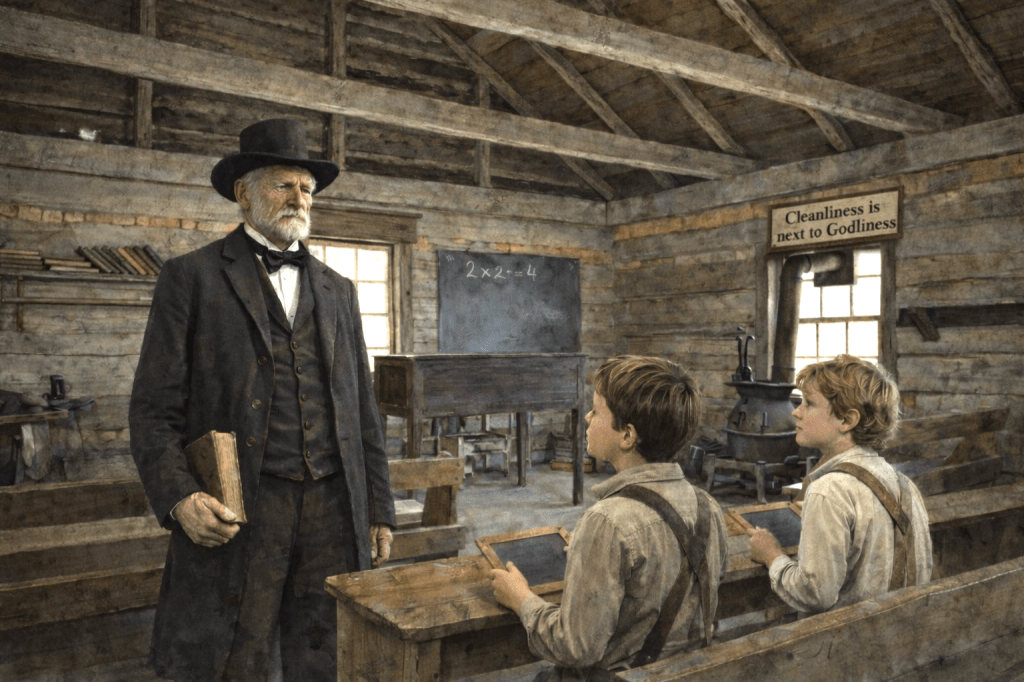
William taught in a one-room rural school in Jackson Township. Instruction centered on memorization and recitation, with students of many ages learning together. Textbooks commonly included Webster’s Blue-Backed Speller and The New England Primer, though materials varied from town to town. A typical day began with prayer or Bible reading, followed by lessons in spelling, reading, writing, and arithmetic. Discipline was firm, sometimes involving corporal punishment, as maintaining order among a wide range of ages required steady authority.
Character and Reputation
In a frontier township school, a teacher such as William Rose would have earned the respect of parents and neighbors alike. He would have been regarded as firm yet fair, capable of maintaining good order in a mixed-age classroom while imparting practical and meaningful instruction to his students. Skilled in penmanship and knowledgeable in arithmetic, William would also have been expected to model moral integrity in both conduct and speech. In that era, formal credentials mattered far less than character and reputation.
Later Years and Legacy
The 1850 United States Census lists William Rose as a teacher living in Jackson Township, Ohio, at the age of sixty-five—evidence of long experience and the trust of his community. He died on August 29, 1852, in Jackson Township, Jackson County, Ohio.
A book on the grave of the long time teacher William Rose
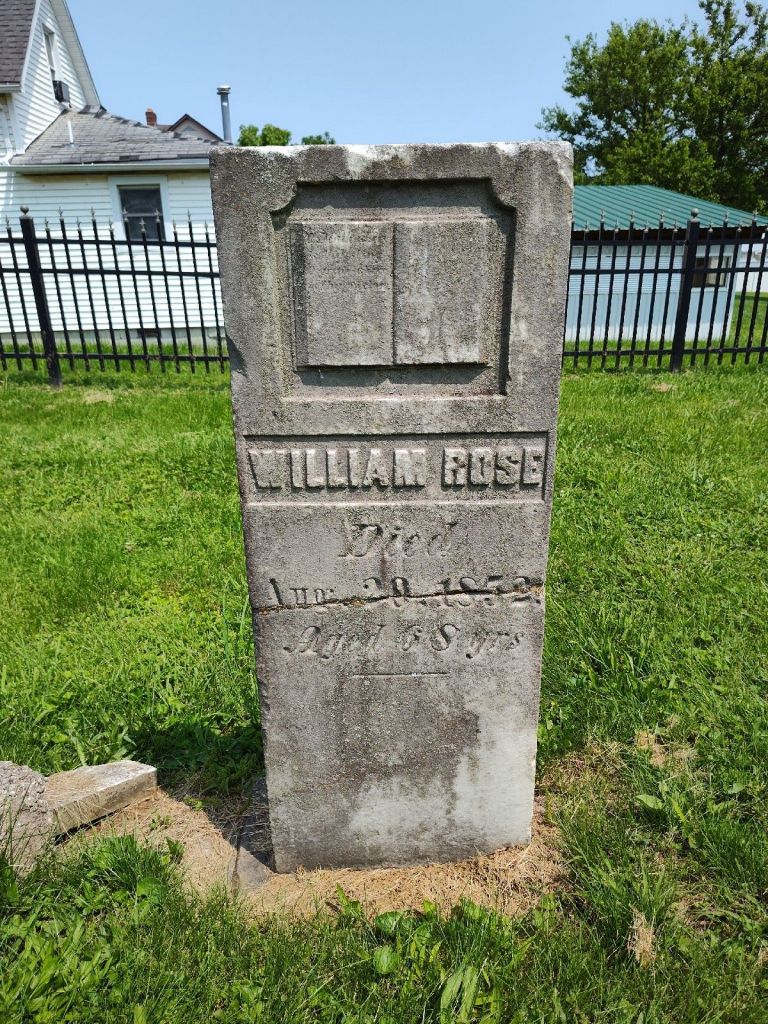
Gravestone of William Rose (1785–1852) a pioneer teacher, James Cemetery, Jackson Township, Ohio.
William Rose is remembered as part of the generation that helped establish and sustain early common schooling in frontier Ohio. His life reflects the character, dedication, and quiet leadership that shaped education in the early nineteenth century American Midwest. William’s son who was also named William Rose moved to Vermont Township, Fulton County, Illinois in the late 1830s. He died in Vermont, Illinois in 1889.
 Farr's of Fulton County, Illinois