The Farr Family migrated west during the great expansion of the United States. By 1830 our family lived in Anderson Township, Ohio a small town outside of Cincinnati, having moved from Pennsylvania. Three brothers Cooper, Samuel and William Farr and a sister Elizabeth Farr Lindsey left Ohio in 1836 to settle in Fulton County, Illinois. They undertook a difficult three hundred and fifty mile journey to Illinois in covered wagons, crossing Indiana and half of Illinois to reach Fulton County.
Farm life in Fulton County in the 1800s
What was living on a farm in Fulton County like in 1845? You went to the store for only flour, coffee, and sugar, things you couldn’t grown on the farm. You would grow your own linen (hemp was preferable to flax for durability and comfort), and wool. Simple homesteading in the 1840’s meant you learned how to knit, spin and weave, and use only your own feet (or those of a horse) for transportation. You would dig your own well, do your own blacksmithing and maybe starve in the winter when you had a bad crop.
Families were large in the 1800s, a family might have 10-18 children, all born at home, and half of them would die before the age of five because of dysentery, typhoid, scarlet fever or measles. Children and parents got up with the sun to work on the farm. At night they might read by the light of the drafty fireplace. This describes Elizabeth Lindsey’s life and that of most Americans in the early to mid 1800s. Kathy Belt, Countryside Magazine, September/October 2012.
The 1830’s – Words from the past about Fulton County
“My father had determined upon seeking a new home in Illinois as early as 1836, but was deterred by wild reports of Indian troubles in the state.”
“In the fall of 1837 we left the old Ohio home on the Little Darby Creek and started overland with ox teams for Fulton County, Illinois. I well remember the long and tedious journey. We brought one horse through with us, which was ridden by different members of the family alternately. We were four weeks making the journey from Ohio to Fulton County, but we finally reached our destination…”
“I recall one incident of our journey from Ohio to Illinois. Somewhere in Indiana we sought shelter in the cabin of a settler, from a rainstorm, and obtained permission to stay over night. About dark some relatives and friends of our host came in and we were crowded out into the darkness and wild storm. It was a terrible night, but we were finally taken in by a neighbor and cared for; but wet, cold and hungry we traveled for several miles before finding a stopping place.”
“I was reared on the farm amid pioneer influences and what education I have was secured in log school houses and on the subscription or pay-school plan. I began my school life in Ohio and ended it in Illinois….The attendance of pioneer children at the subscription schools was generally about three months in the year. The chief ability of some of the old time schoolmasters lay in drinking whiskey which was used at that time by almost every family. The old master or teacher, would sit on a splint bottom chair while the little urchins stood before him to answer questions, with the expectation of having the big hickory cudgel come down over their shoulders if an error was made.”
“We children were supplied with homespun clothing through the efforts of our devoted parents-especially our mother, who, like many another pioneer woman, bore a large share in the burdens with which life here in an early day abounded.”
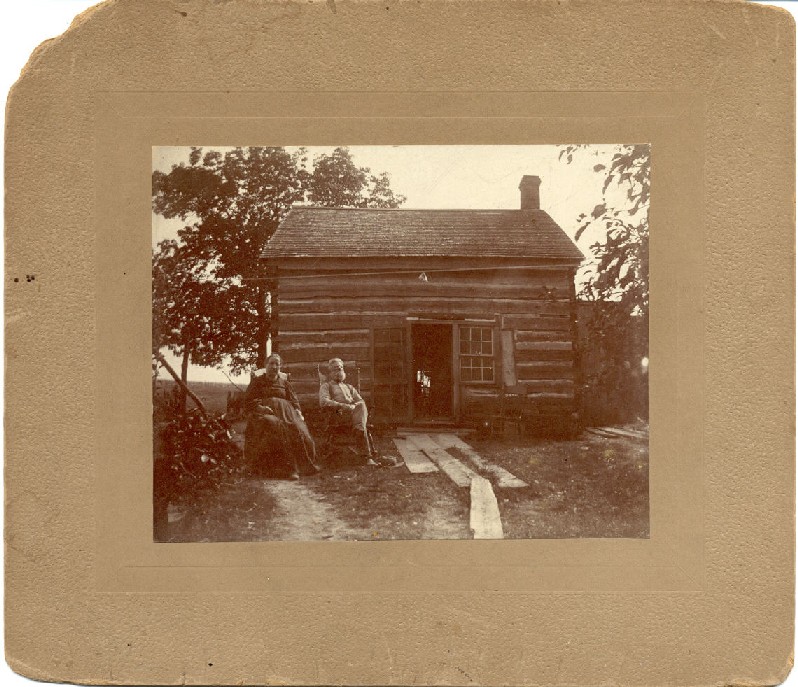
“We lived in a cabin built of round logs, neither sawed timber nor nails, if I remember rightly, being used in its construction. The floor was made of puncheon and the boards that covered the roof was rived by hand and held in position by weight poles. Deer, wild turkey and other game were plentiful but bread stuffs were scarce. However, we lived near Ellisville (22 miles north of Ipava) and generally had bread at every meal. Ellisville, at the time of which I speak, was quite a trade center, and we did our trading there. It had its quota of live businessmen and it was predicted that in time it would become a city. But like many of the pioneer towns of the county it has seen its best days.”
“Wolves were numerous and we were compelled to keep sheep in a pen at night, near the house, to protect them from the ravages of these animals. Father was a good shot and was fond of hunting and we often had wild meat on the table. One time he killed a deer upon Cedar Creek and having no knife with him he skinned and dressed it with a sharp-pointed nail. Oh, yes my father brought down many deer, turkeys, foxes, wildcats and wolves with his tryst rifle.”
“With happy hearts and the cheerful laughter of children we used to venture forth in the woods to gather wild flowers, pick blackberries, plums and other wild fruits, and I can never forget those old, old days in Fulton County. I have seen and experienced much pioneer life and know something about the toils and privations of the early settlers of the county-but do you know that the history of pioneer life generally presents only the dark side of the picture? We had our seasons of relaxation-our seasons of fun and enjoyment. We contrived to do something to break the monotony of our everyday life. We had our quilting bees, cornhuskings, houseraisings and logrollings. At night we had our parties and a general good time. The recreation afforded to the young people on the recurrence of these festive occasions was as highly enjoyed, and quite as innocent, as the amusements of the present boasted age of refinement and culture.”
“The furniture of the pioneer cabin was as primitive as its occupants. The first settlers of Fulton County were a plain, simple, hospitable people, and the latchstring was always hanging out. We were all poor and dependent and were all on an equal footing. Sometimes whole families would be sick at one time and the neighbors would go in and take care of them. The chills and fever seemed to be the worst disease with which we had to contend, and quinine and boneset tea were used in every family. It was a terrible disease and was one of the greatest obstacles to the early settlement of the county.”
“There were no matches in those days and we often had to borrow fire from a neighbor-and we sometimes had to fight fire too, for the prairie fires each fall were something to be dreaded. Fires would visit the great grassy plains every autumn and we had to take great precautions to prevent our crops and buildings from being destroyed. These fires would spread very rapidly and words cannot convey the faintest idea of the splendor and grandeur of one of these conflagrations at night.” Written by Mahala Mills this recounts her early memories about moving to Fulton County which she wrote in 1906. Her experience was shared by the Farr’s and other pioneer families who settled in Fulton County in 1830’s and 1840’s.
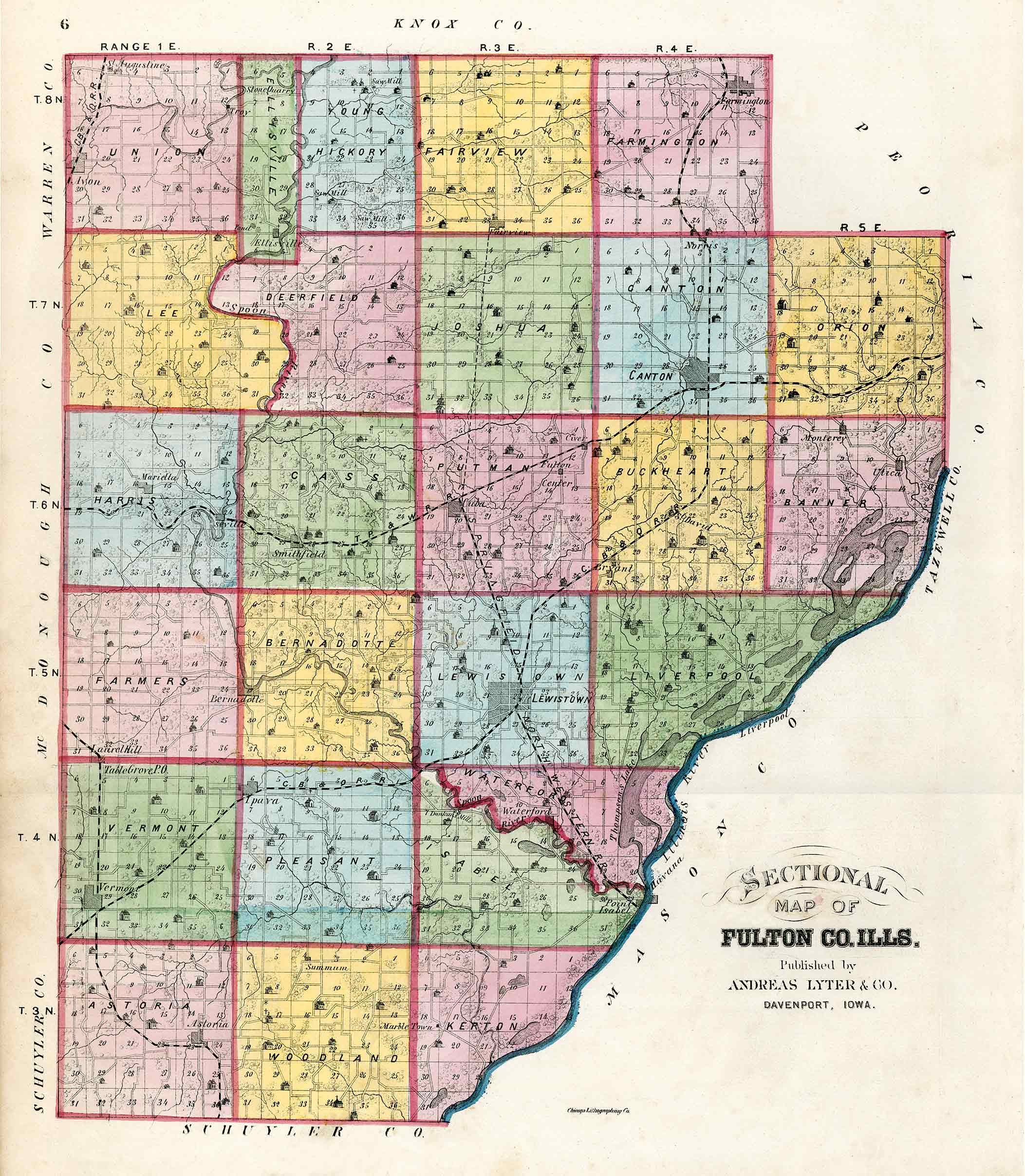
The population of Fulton County, Illinois in 1860 was 33,338 which is about the size of the county today. Farm life was difficult especially by today’s standards. Women did all the spinning and knitting, sewing and weaving-in addition to other household chores. Women in Ipava, Illinois would attend church meetings on Saturday afternoons, taking their knitting along with them to church. People who lived within a radius of two miles of the church generally walked to services on Sundays. When the weather was warmer some women would travel barefoot, carrying their shoes and stockings and when they got near the church they would put on these articles of dress. Perhaps Zuby Predmore Farr did the same, while walking to church with her children and husband. Those who rode to church went on horseback, or in the big farm-wagons. Everybody went to church, including the babies.
Preaching the Gospel
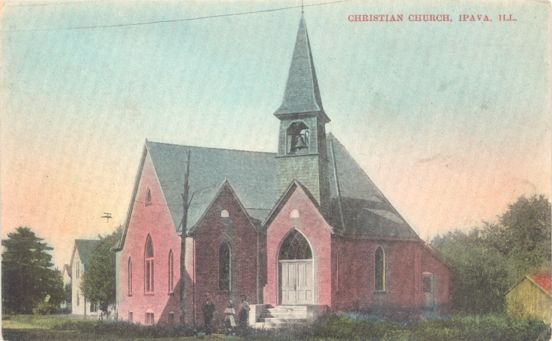
The three small churches in Ipava during the 1880’s were all Protestant. The Presbyterian Church in Ipava was built in 1858 at a cost of $2,000 dollars. The pastor in 1879 was Rev. E. Quillin. The Christian Church building was built in 1854, originally by the Methodists and then sold to the Christian Church. In 1867, the Methodists built a new brick building, with a basement at a cost of $12,000.
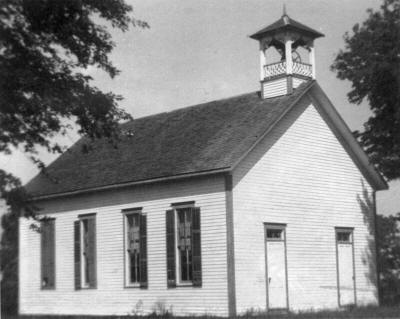
The original Christian Church in Ipava, a Protestant denomination affiliated with the Disciples of Christ was organized in 1842 by William Howard. The 1830’s and 1840’s saw a steady emigration of settlers from Ohio and Kentucky into the southern part of Fulton County, which included the Farr’s. Among these early settlers was a young man named William P. Howard who formed the first Christian church congregation in Ipava. Rev. Howard held church meetings from house to house. A schoolhouse of round logs, chinked and daubed with mud and straw, clapboard roof, with puncheon seats and floor, was initially. build. In this building meetings were held and the congregation formed. The church site was four and one-half miles southeast of Ipava, built on property that may have been donated by Samuel Farr, his land was right next to the church. Soon this building was too small to accommodate the worshipers and a somewhat larger church was built. It was 30 by 40 feet, with eight feet to the ceiling logs and poles, and roof of lap shingles, riven and shaved. The siding and furnishing were of walnut. This came to be known as the Howard Church. Rev. Howard ministered to his congregation for sixteen years without receiving any money from his congregation. He supported his family by farming. By 1867 the Howard Church building was dilapidated and the congregation disbanded. Part of the members including the Farr’s went to the Washington Schoolhouse, where Dr. J.H. Breeden built up a congregation. In 1869, they purchased the old Methodist Episcopal chapel in Ipava and repaired it. In addition to Dr. Breeden, P.D. Vermilion, M.T. Cooper and L.M. Robinson served as pastors of the church. William and Zuby Farr continued with this congregation because Rev. Cooper performed Zuby’s funeral service in 1879. In 1895, a new Christian Church was built in Ipava and the old building was sold.
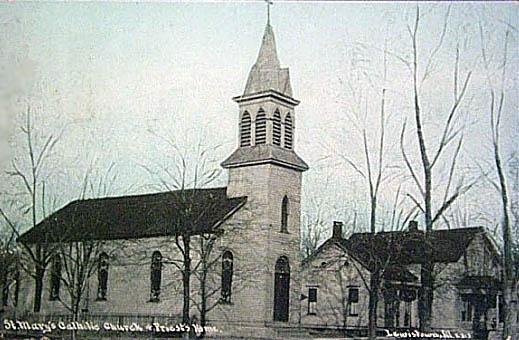
Fulton County is part of the Catholic Diocese of Peoria, during the 1820’s the counties that currently make up the Diocese of Peoria were included in several other diocese, including Bardstown, Kentucky; St. Louis, Missouri and Vincennes, Indiana. In 1843, the Diocese of Chicago was formed, encompassing the entire state of Illinois. The coming of the railroads in the 1840’s caused a growth spurt in the Catholic population in central Illinois. Many new churches were built, most of which served a specific ethnic group. The 1850’s found Catholics, in particular Catholic immigrants, the targets of bigotry in many parts of the United States. In fact, in order to build a church, Catholics in Galesburg for example had to challenge a town charter that prohibited the sale of land for that purpose. In spite of these setbacks the Catholic population in central Illinois grew and flourished. St. Mary’s in Lewistown was established in 1865. It was the nearest Catholic Church to Ipava.
What did they eat in the 1800s?
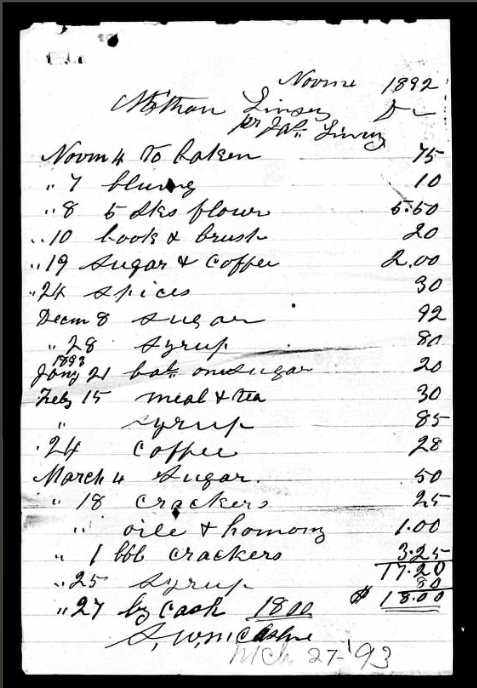
Corn and beans were common, along with pork. In Illinois, cows provided milk, butter, and beef. Preserving food before the era of refrigeration, required smoking, drying, or salting meat.
Cooking even a “simple family dinner” in the 1860s was a very heavy duty process. Factory produced canned goods and prepared ingredients were not widely available or of reliable quality until the end of the century, and the typical working conditions in the 1860s kitchen were quite basic, even in affluent homes. Families tended to be larger as well, so larger meals were more common.
Without refrigeration, cooks planning meals in the nineteenth century had to rely on foods that were in season, or items that they had preserved themselves during another part of the year. In many areas how kitchens were used was seasonal in nature. In hot summers much of the cooking would be done outside in the open air or in a specially built building often called a summer house or summer kitchen. This kept the heat of cooking and laundry out of the main house, since there was no way to cool down a house once it got hot on a summer’s day. (Brian Tomlin 2013)
 Farr's of Fulton County, Illinois