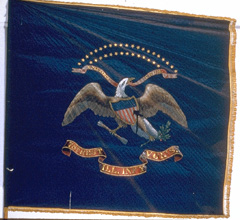
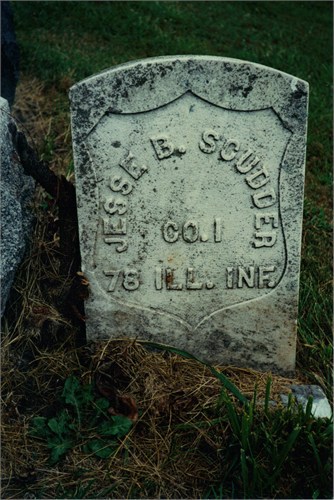
The death toll was staggering over 36,000 men were killed or wounded in the Battle of Chickamauga, but Sergeant Scudder survived the heat of battle. Jesse B. Scudder started out as a private in the 78th Illinois Infantry during the Civil War and rose to the rank of sergeant during his service in America’s worst war. Scudder enlisted in the Union Army on August 11th 1862 in Fulton County, Illinois.
In 1862, Jesse B. Scudder entered the army as a private in Company I of the 78th Illinois Infantry, his height according to records was 5′ 11 1/2″ tall, he had brown hair and blue eyes and his complexion was listed as dark. Jesse was married at the time of his enlistment, his occupation was listed as a farmer. He was born on December 19, 1831 in Liberty, Butler County, Ohio, but his family had moved west to Illinois which is where he grew up.
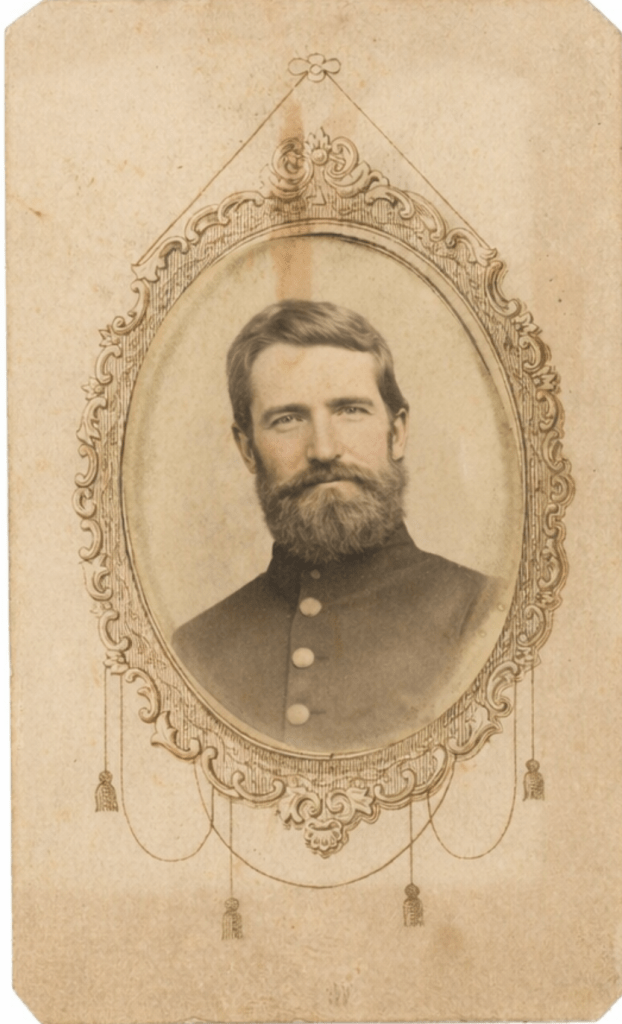
Sergeant Jesse B. Scudder 78th Illinois Infantry
The American Civil War occurred between 1861-1865. Scudder was 31 years old when he joined the United States Army, commonly referred to as the Union army. His muster record showed that Captain Reynolds signed Jesse to three years of service. The muster-in date for Jesse Scudder was 1 September 1862 and the muster-in place was Quincy, Illinois. His muster-out date was June 7, 1865. The muster-out place was Washington, D.C. He was mustered-out by Lt. Scroggs who remarked on the record that Sergeant Scudder was absent at muster-out because he had been sent home to Illinois by train due to war injuries.
He was left by his regiment at a hospital in Chattanooga, Tenn. on October 18, 1864. According to government records “He was granted a furlough, and on October 31, 1864, was on his way home along with a lot of other sick soldiers, under the charge of William H. Gibens, assistant surgeon of the said regiment. That at or near LaFayette, Ind. the train upon the railroad upon which said soldiers were traveling collided with another train and a large number of the soldiers aboard were killed, and a large number of the remainder were crippled and injured in various ways by reason of said collision.” House of Representatives Report May 18, 1886. Sgt. Scudder survived the train crash though his injuries were compounded by the crash.
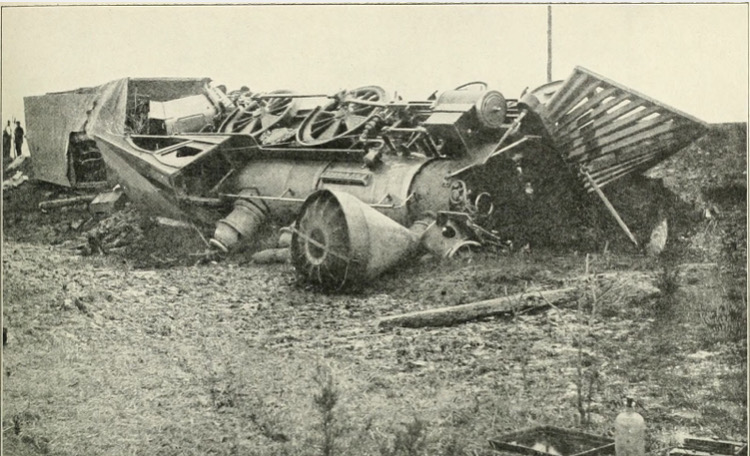
Train crash 1865
Records show his residence place at time of enlistment was Industry Township, McDonough County, Illinois. Record Source Illinois Civil War Muster and Descriptive Rolls.
The war began for Jesse Scudder on September 19, 1862 as he and the 78th Illinois moved by steamboat from Quincy, Illinois, down the Mississippi River, then up the Ohio River to Kentucky. For the remainder of the Civil War he fought for the Union in one battle after another.
Defense of Kentucky Railroads
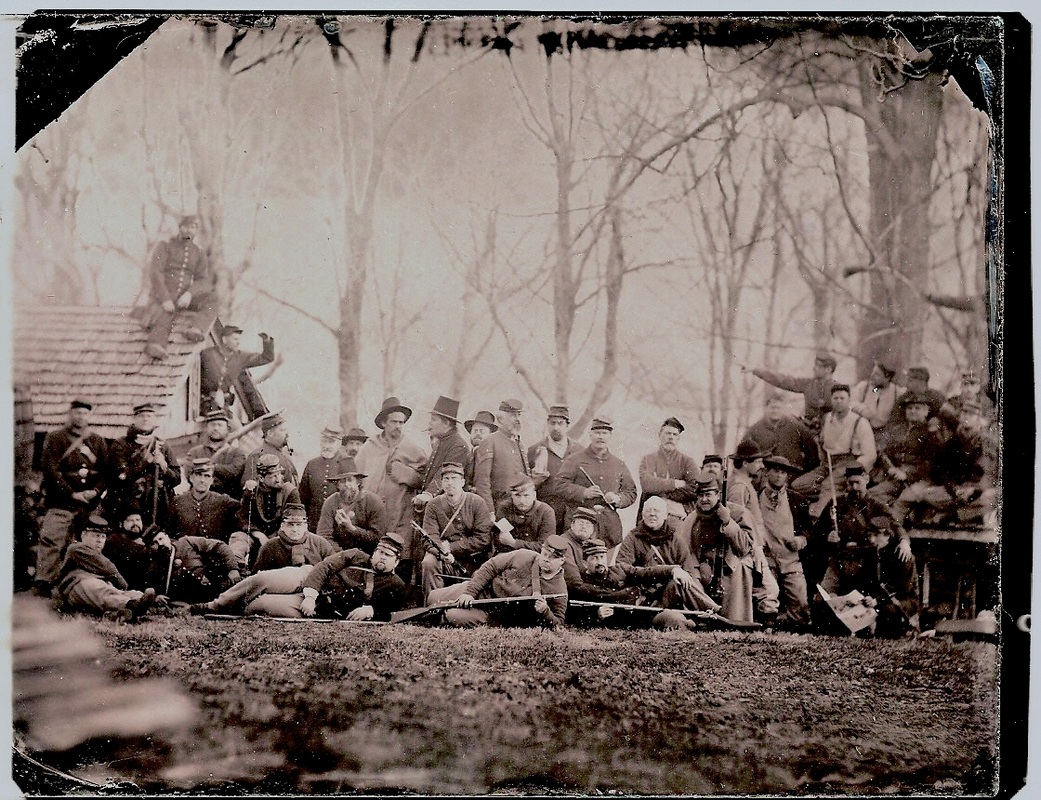
Defense of the Kentucky Railroads by the 78th Illinois Infantry
Between October 5, 1862 and January 30, 1863, the 78th Illinois Infantry was stationed in Shepherdstown, Kentucky to guard the Louisville & Nashville Railroad and a spur line between Bardstown Junction and New Haven. The regiment’s headquarters was in New Haven.
The regiment was split up, with one to three companies guarding each key bridge. On December 28, 1862, Companies B and C were stationed at one of these bridges when they were attacked by Confederate General John Hunt Morgan’s cavalry. The Union companies had no artillery to return fire, and were forced to surrender. They were paroled and sent to Union camps in Louisville and St. Louis until they could be exchanged.
On December 30, 1862, Company H at New Haven was also attacked by Confederate forces.
On January 30-February 7, 1863, the 78th Illinois Infantry moved to Nashville, Tennessee. Sergeant Scudder was a member of Company I.
Summary:
The 78th Illinois Infantry played an important role in defending the Kentucky railroads from Confederate attack. The regiment suffered some casualties, but it helped to ensure the continued operation of these vital transportation links.
Middle Tennessee Operations
Between February and April 1863 Jesse Scudder and the 78th Illinois Infantry were part of the Union repulse of Confederate General Nathan Bedford Forrest’s attack on Fort Donelson, Tennessee occurring February 12 through June 23, 1863. They then moved to Franklin, Tennessee where they fought the Confederates.
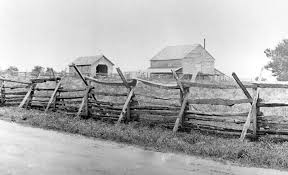
Tullahoma Campaign
The 78th Illinois was part of the Tullahoma Campaign on June 24 and July 3, 1863 June 24–28, 1863. They marched to Triune, Murfreesboro and then on to Shelbyville on July 1, 1863. The 78th was part of the occupation of Shelbyville and Middle Tennessee through August 1863.
Chickamauga Campaign
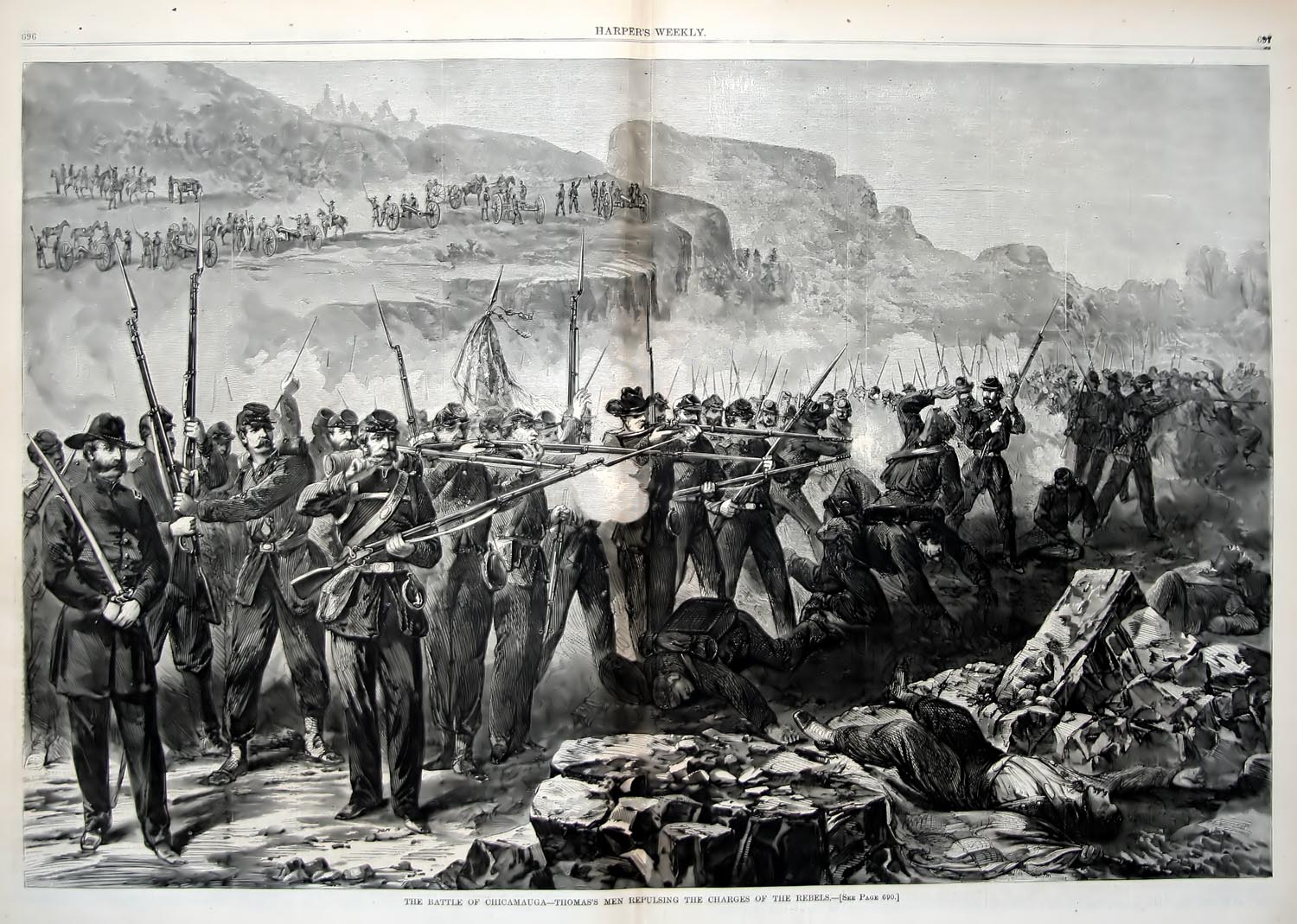
Sergeant Scudder and the Chickamauga Campaign
The Chickamauga Campaign was the bloodiest battle in the Western Theater of the American Civil War. It took place from August 16 to September 22, 1863, with the actual Battle of Chickamauga taking place on September 19 and 20, 1863.
Sergeant Scudder fought in the Chickamauga Campaign as part of the 78th Illinois Infantry Regiment. On the final day of the battle, the 78th Illinois played a vital role in reinforcing Union General Thomas at the height of the Confederate attack. The regiment suffered heavy casualties, with 40% of its soldiers killed or wounded. Sergeant Scudder survived the battle, but he lost many of his comrades.
There were 34,624 dead and wounded soldiers after the fighting stopped at Chickamauga.
The Battle of Chickamauga was a tactical victory for the Confederates, but it was a strategic victory for the Union. The Union army was able to hold Chattanooga, Tennessee, which was a vital transportation hub. The battle also marked the end of the Confederate offensive in the West.
Sergeant Scudder’s bravery and sacrifice are a testament to the courage and determination of the Union soldiers who fought in the Chickamauga Campaign.

Sergeant Scudder and the Chattanooga Campaign
The Chattanooga Campaign took place from September to November 1863. The Siege of Chattanooga, Tennessee, took place from September 24 to November 23, 1863. Sergeant Scudder was injured during the Siege of Chattanooga, and was left behind in a Union hospital. During the heat of battle, Sergeant Scudder’s finger was shot off. The 78th Illinois continued to fight in a series of battles until the end of the war.
Here is a timeline of the 78th Illinois Infantry’s participation in the Chattanooga Campaign:
- November 23-24, 1863: Tunnel Hill
- November 24-25, 1863: Missionary Ridge (temporarily attached to 15th Army Corps on November 24)
- November 26, 1863: Chickamauga Station
- November 29-December 17, 1863: Marched to the relief of Knoxville
- February 22-27, 1864: Demonstration on Dalton, Georgia
- February 23-25, 1864: Tunnel Hill, Buzzard’s Roost Gap, and Rocky Faced Ridge
- April 11-13, 1864: Reconnaissance from Rossville to La Fayette
The 78th Illinois Infantry played an important role in the Chattanooga Campaign. The regiment fought bravely in a number of battles, and suffered heavy casualties. Sergeant Scudder’s injury is a reminder of the sacrifices that Union soldiers made during the Civil War.
Note: The 78th Illinois Infantry was temporarily attached to the 15th Army Corps on November 24, 1863, for the Battle of Missionary Ridge.
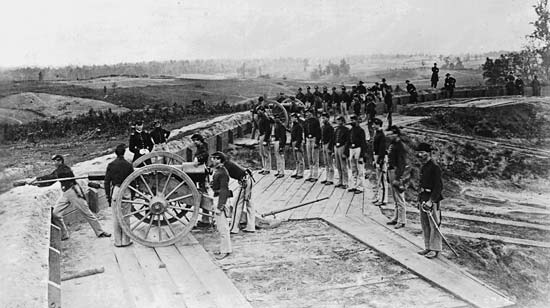
78th Illinois Infantry in the Atlanta Campaign
The 78th Illinois Infantry Regiment participated in the Atlanta Campaign from May 1 to September 8, 1864. The campaign was a series of battles fought between the Union and Confederate armies in northwest Georgia during the summer of 1864. The goal of the campaign was for the Union army to capture Atlanta, a major railroad hub and industrial center.
At the Battle of Kennesaw Mountain, Sgt. Scudder had his finger shot off during fighting. Several other members of Company I were also wounded. Robert Laughlin received a flesh wound to his right arm, George Hogue became deranged by the explosion of a shell near him and John Pembroke was severely stunned and his gun was knocked to pieces by an explosion as reported in the Macomb Journal on July 29, 1864.
The 78th Illinois Infantry fought in a number of battles during the Atlanta Campaign, including:
- Tunnel Hill (May 8-11)
- Rocky Face Ridge (May 8-9)
- Buzzard’s Roost Gap (May 9-13)
- Resaca (May 17-18)
- Dallas (May 25-26)
- New Hope Church (June 9-July 3)
- Marietta (June 11-14)
- Pine Mountain (June 15-17)
- Lost Mountain (June 27)
- Kennesaw Mountain (June 27-July 2)
- Ruff’s Station (July 4)
- Smyrna Camp Ground (July 5-17)
- Chattahoochee River (July 19-20)
- Peach Tree Creek (July 22-August 25)
- Atlanta (August 5-7)
- Utoy Creek (August 25-30)
- Jonesboro (September 1-2)
The 78th Illinois Infantry played an important role in the Atlanta Campaign. The regiment fought bravely in a number of battles, and suffered heavy casualties. The regiment’s participation in the campaign helped the Union army to achieve its goal of capturing Atlanta.
78th Illinois part of the Army led by General Sherman

Post War Activities of the 78th Illinois Infantry
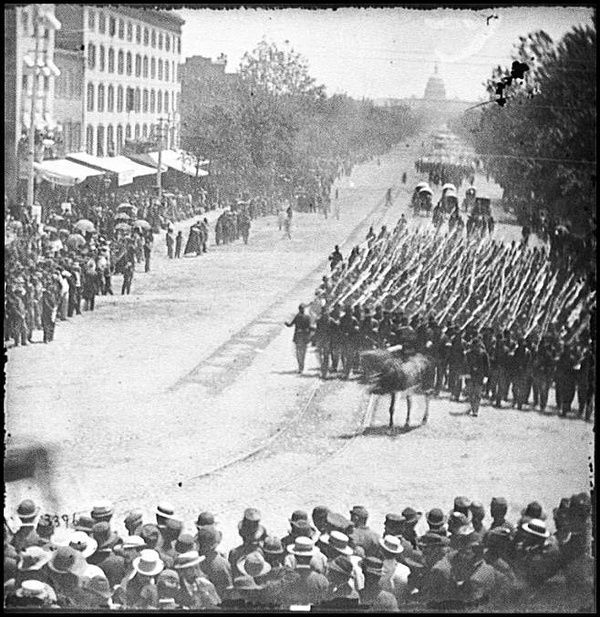
From April 29 — May 19, 1865 the 78th Marched to Washington, D.C. — via the Confederate capital of Richmond, Virginia. Nothing like seeing the conquered capital of your enemy. On May 24, 1865 the 78th Illinois participated in the Grand Review parade in Washington, D.C. On June 7, 1865, Sergeant Jesse Scudder was officially mustered out of the Union Army. Sergeant Scudder had fought in 17 hard battles during his time with the 78th Illinois Infantry.
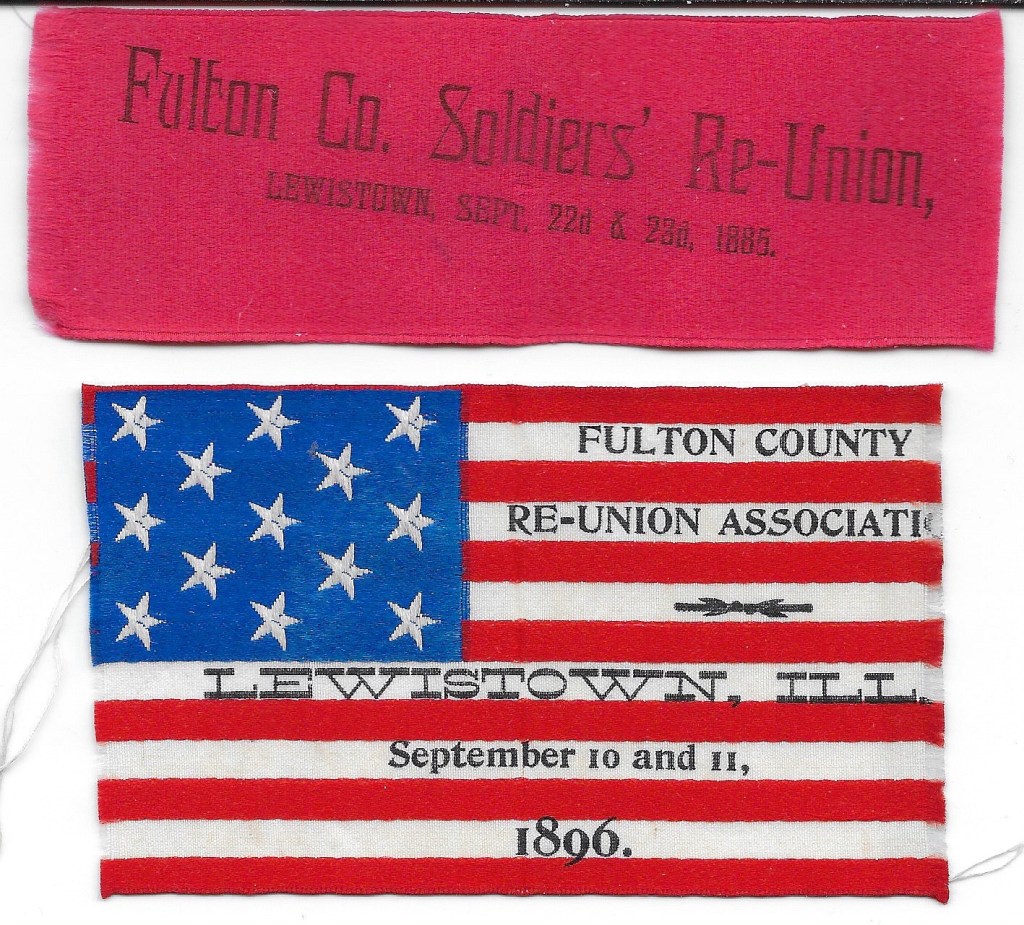
Jesse Scudder was a member of the Grand Army of the Republic (GAR) which was a fraternal organization composed of Union veterans. It was founded in 1866 in Decatur, Illinois which was about a hundred miles southeast of Industry. The GAR grew to include thousands of posts across the North and West of the United States. Pictured below are two ribbons from reunions held in Fulton County.
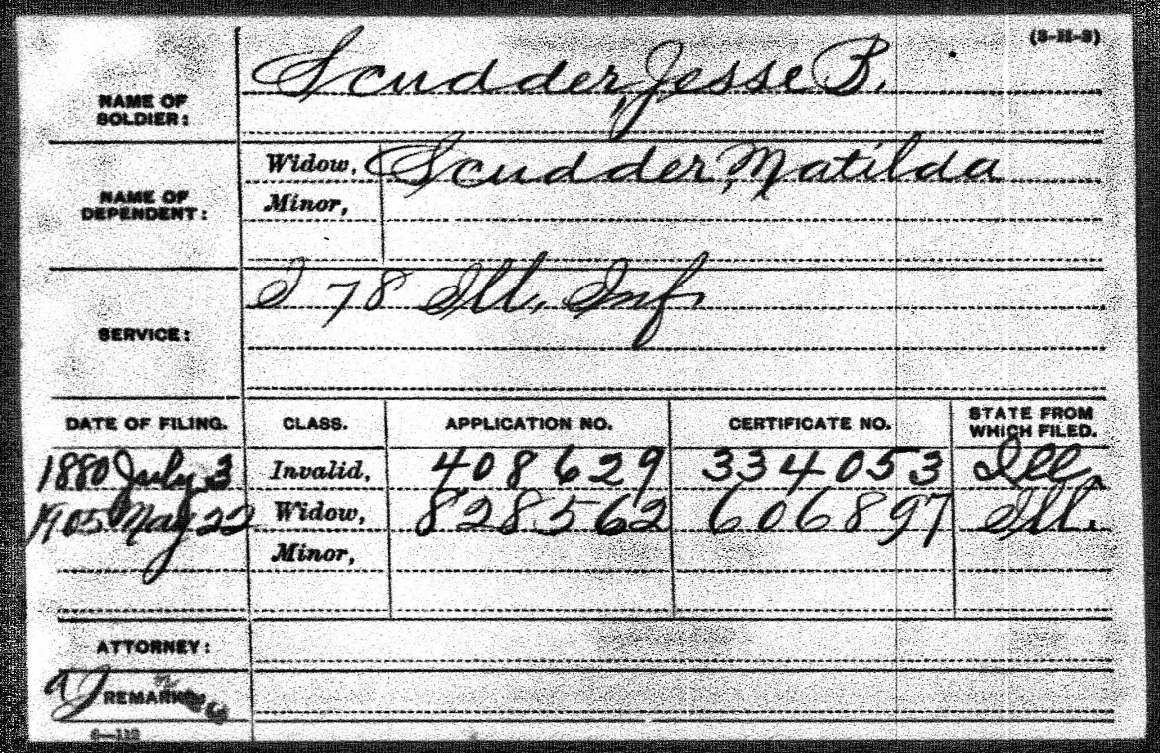
After the war Jesse lived in Industry, Illinois a small farming village located in McDonough County. Matilda Ann Springer Scudder Jesse’s wife had stayed home with the children (Ella, Alpha and Dustin) during the war while Jesse was in the infantry. Jesse and Matilda were married in Industry on January 2, 1856. They had six children together and one more Ella from Jesse’s first wife Sarah Van Gorden who died in 1854. Jesse was the great grandfather of Thelma Landis Farr, a secretary for the Superintendent of Schools for Macomb, Illinois and later a bank teller. She died in California in 1966.
 Farr's of Fulton County, Illinois