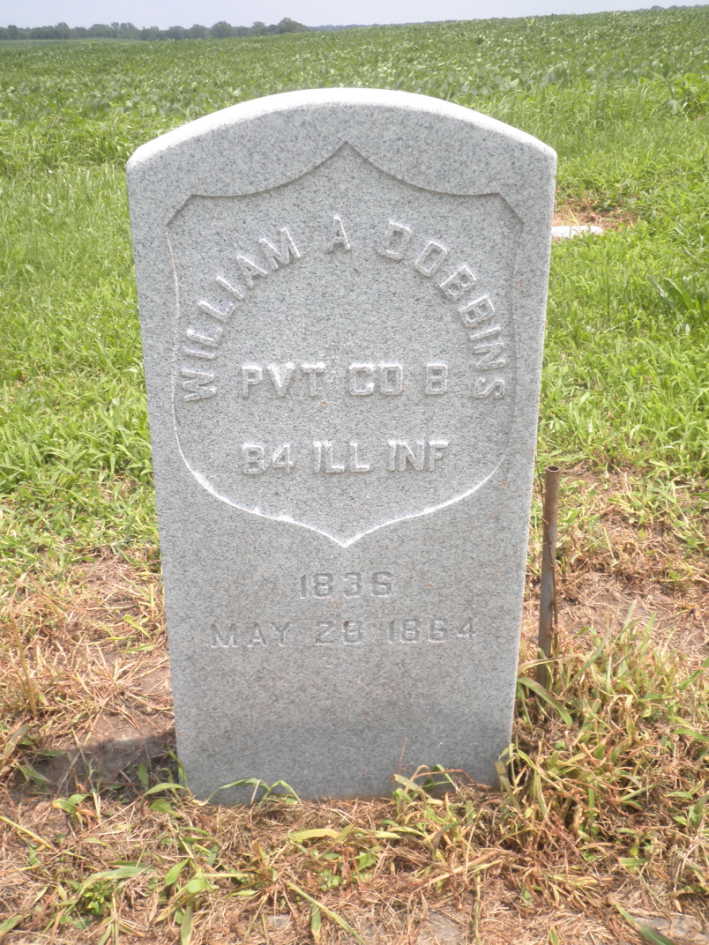
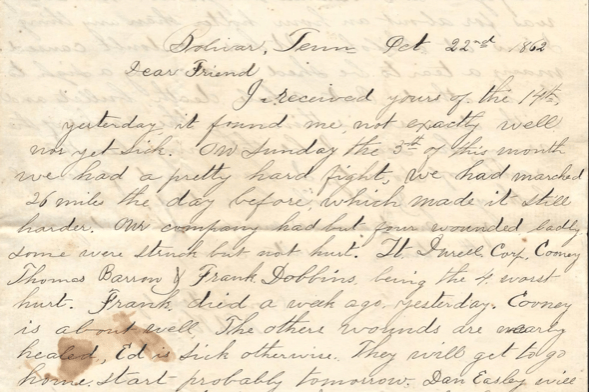
Twenty-one men related to the Farr Family who lived in Fulton and McDonough County, Illinois served in the Civil War, all but one served in the Union Army. Three of the 21 who fought in the Civil War, William Alexander Dobbins (uncle), Franklin Harvey Dobbins (nephew) and Daniel Webster Wyatt died during the war from wounds received in battle. All three were relatives of the Farr’s. Read more about their heroic service in the Civil War below.
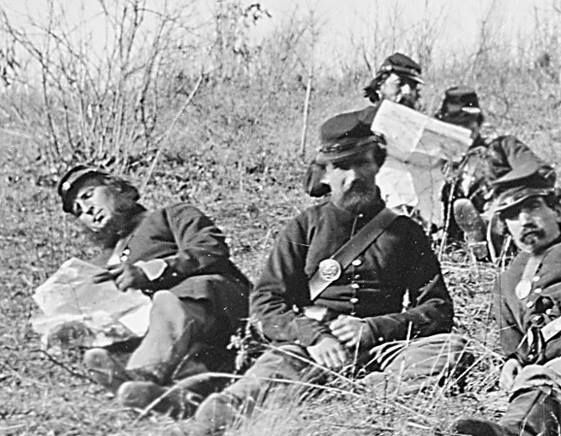
Robert T. Thomas served as a Corporal in Company H of the 28th Illinois Infantry during the Civil War. He dedicated five years of his life to the United States Army during this pivotal period in American history.
His military journey began when he enlisted on September 1, 1861, at the age of 23, initially joining as a Private in Company H, 28th Infantry and later promoted to corporal. During the course of the war, while stationed in Natchez, Mississippi, he re-enlisted on January 5, 1864, committing to an additional three years of service. Robert finally mustered out of the army on March 15, 1866, at Brownsville, Texas.
At the time of his enlistment, Robert Thomas was described as being 5 feet 8 ¾ inches tall, with red hair and blue eyes. He was born in Fulton County, Illinois, on October 8, 1838. After the war, on September 18, 1867, he married Elizabeth A. Koons at the Hotel Standard House in Lewistown, Illinois. Tragically, the couple had twins who passed away on May 16, 1868, and June 4, 1868.
Robert Thomas lived until December 22, 1915, when he passed away in Astoria, Illinois. He was laid to rest at the Ipava Cemetery in Fulton County, Illinois.
His Civil War Pension Application, archived in the National Archives in Washington, D.C., reveals that during the summer of 1865, while stationed at Mobile, Alabama, Robert suffered from rheumatism and chronic diarrhea, which affected his spine and kidneys. His weight declined significantly during his service, from 168 pounds at enlistment to 86 pounds at discharge.
Robert and Elizabeth had three surviving children by 1895: Etta M. (born on July 18, 1869), Arzela (born on December 18, 1871), and Mary E. (born on January 24, 1876). After the war, Robert Thomas resided in Missouri for 1 ½ years, Nebraska for two years, and the remainder of his life in Fulton County, Illinois. In his later years, he lived with his daughter, Emma, in Astoria, Illinois. Unfortunately, in October 1915, he fell victim to robbery, losing his pension papers and $20 to $25 to two young pickpockets at a railroad passenger depot in Canton, Illinois. He passed away just a few months later, on December 22, 1915.
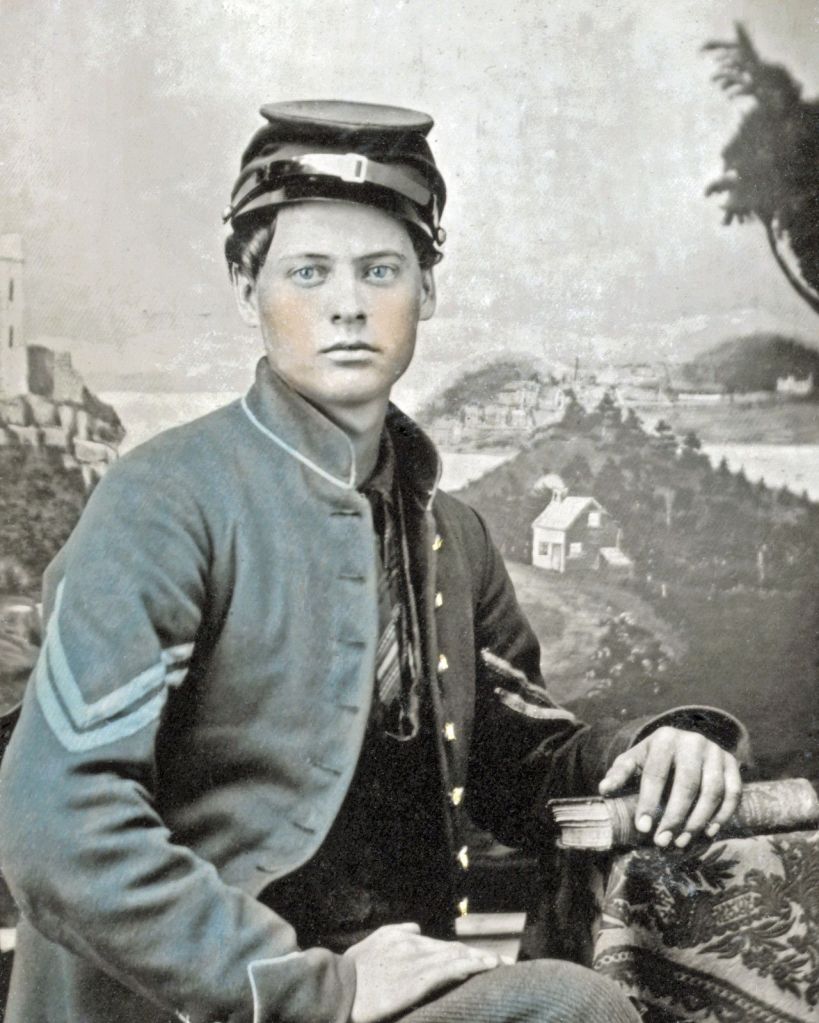
Erastus L. Thomas served as a soldier in the 28th Illinois Infantry, Company H, during the American Civil War. He began his military journey by enlisting as a Private on September 1, 1861, at the age of 19. Over the course of his service, Erastus distinguished himself and earned a promotion to the rank of Corporal. His dedication to duty was evident throughout his time in the 28th Illinois Infantry.
Erastus served with honor until his discharge on September 4, 1864, which coincided with the expiration of his term of service. This significant event took place in Natchez, Mississippi, marking the end of his active duty in the military.
At the time of his enlistment, Erastus was described as standing at 5 feet 8 inches tall, with light hair and hazel eyes. He was a native of Fulton County, Illinois, born on April 22, 1842.
Following his return from the Civil War, Erastus L. Thomas married Jane Dixon in Aledo, Mercer County, Illinois, on July 15, 1873. Unfortunately, Jane passed away in 1881, and the couple did not have any children of their own. However, Miss Ella Brick of Canton, Illinois, was his niece, indicating his close family ties.
Erastus experienced health issues as a result of his military service, particularly suffering from rheumatism affecting his back, shoulders, and left knee. His struggles with these health conditions are documented in his Civil War Pension Application, which is archived in the National Archives in Washington, D.C.
Erastus L. Thomas lived in various locations following the Civil War. From 1864 to 1868, he resided in Bushnell, Illinois. He then moved to Gardner, Kansas, where he lived from 1868 to 1870. Afterward, he relocated to Osborne, DeKalb County, Missouri, where he resided from 1870 to 1907. In his later years, from 1907 until his passing in 1927, he lived at the Illinois Soldiers and Sailors Home in Quincy, Illinois. Erastus L. Thomas passed away on June 12, 1927, at the Home for Soldiers and Sailors in Quincy, leaving behind a legacy of service to his country during the Civil War.
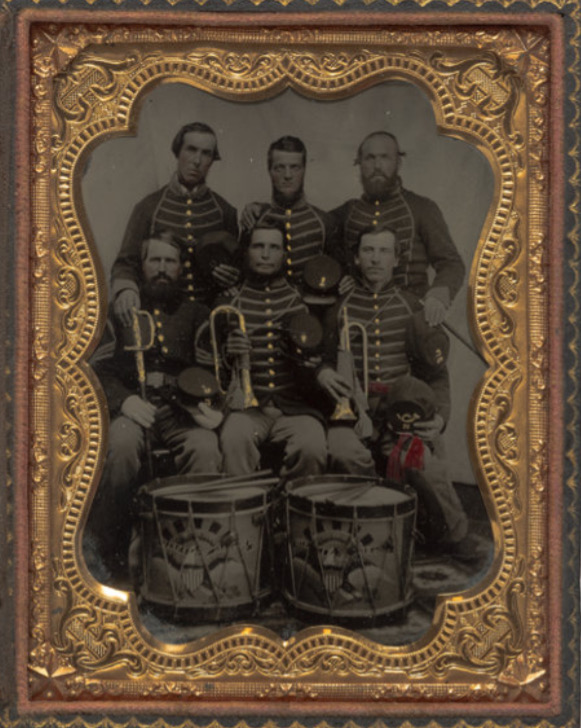
John C. Dobbins was a musician and served during the Civil War in the 151st Illinois Infantry, Company D as a private. He enlisted toward the end of the war in 1865 and mustered out in Columbus, Georgia in 1866. Dobbins enlisted on 15 February 1865 as a musician, 27 years old, he served in Co. D of the 151st Illinois Infantry. He mustered out of the Army on 24 January 1866 at Columbus, Georgia. His enlistment papers describe him as 5’8” tall, having auburn hair and hazel eyes. He was born in Illinois. After the war, John Dobbins had an occupation as a mail carrier in Kansas City, Missouri. He married to Katherine Lindsay. John died in Leavenworth, Kansas on 5 November 1924. Dobbins, John Calvin—Civil War Pension Application, National Archives, Washington, DC. John was born 4 November 1844 in Fulton County, Illinois, according to the Dobbins family Bible. John Dobbins and his wife Katherine Henderson Lindsay were living in Ipava, Fulton County, Illinois on 13 November 1867. John’s military pension was based on rheumatism and heart disease. In 1865, the family moved to Creston, Iowa, then two years later to Chariton, Iowa. In 1924, they lived at 5317 Harrison Street, Kansas City, Missouri.
John Calvin Dobbins Jr. was one of eight children born to John Calvin Dobbins Sr. and Harriet Miller. Three of his brothers served in the Civil War, as did John. Only Robert and John survived.
John C. Dobbins and Katherine Henderson Lindsay were married on the 13th of November 1867 at Ipava, Fulton County, Illinois. Katherine was the daughter of Elisha and Elizabeth Lindsay. They had two children: Fred Everett Dobbins who was born in 1872 and Bessie Aldiene Dobbins (Russell) who was born in 1877.
By 1880 the Dobbins were living in Lucas County, Iowa, where John was a butcher. They lived for many years in Creston, Union County, Iowa where John worked as a city mail carrier.
In 1924, they were living in Kansas City, Missouri. John died on November 5, 1924 at the National Military Home at Leavenworth, Kansas, the day after his 80th birthday.
Katherine moved to Henry County, Illinois, where she lived with their daughter, Bessie Russell, and family. She died in 1940 at the age of 92 years, 8 months, and 3 days. John and Katherine are both buried at Sidney, Iowa, where Katherine’s parents are buried.
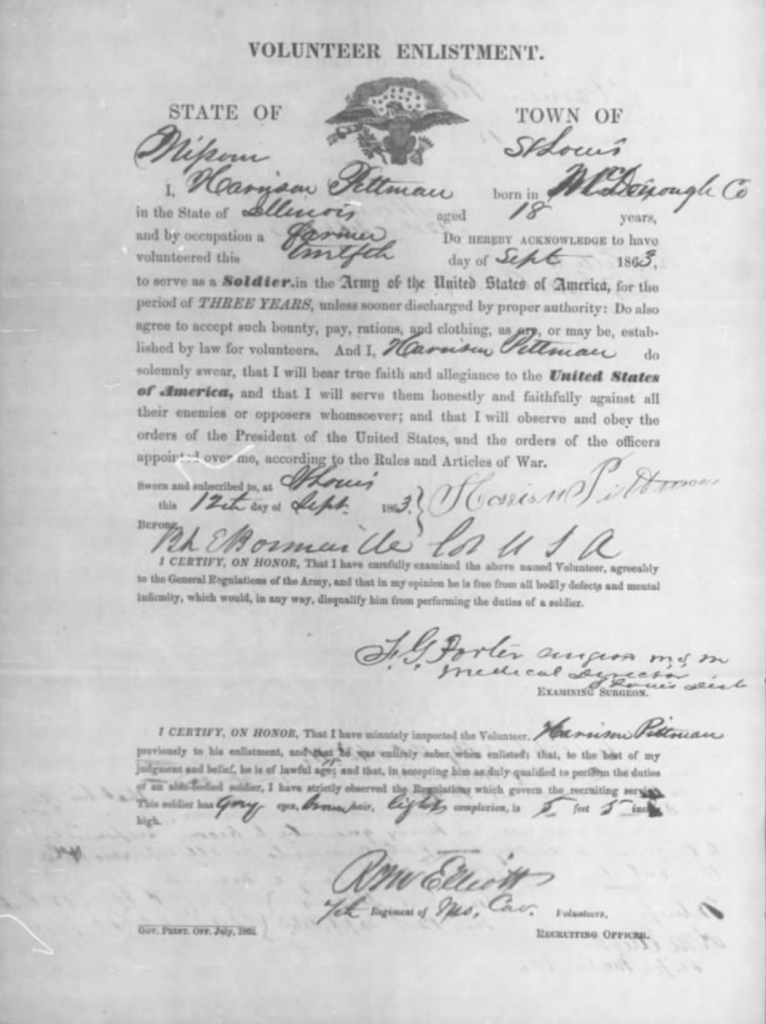
Harrison Pittman served in the 7th Missouri Cavalry (Union) Company D as a private. Harrison L. Pittman and the 7th Missouri began operations in the Civil War around Miami and Waverly, Arkansas from May 25 to the 28 in 1862. The following is a list of action that the 7th Missouri participated in during the war: Scouts were sent to Waverly, Miami, Franklin and Pink Hill on June 4 through the 10th (Cos. “H” and “I”). Pink Hill June 11 (Detachment). Haytown June 23 (Co. “B”) Operations about Sibley and Pink Hill took place from June 28 to July 1, 1862 and included companies “B,” “D,” “F” and “K” which specifically involved Harrison Pittman. Lotspeach Farm, near Wadesburg, July 9. The 7th Missouri Cavalry went on expeditions in Cass County on July 9-11, 1862; on Blackwater, near Columbus, July 23. Lone Jack August 16 (5 Cos,). Occupation of Newtonia October 4. Battle of Prairie Grove, Ark., December 7. Van Buren December 21. Expedition over Boston Mountains December 27-29. Moved to Flat Creek February, 1863; then to Rolla, Mo. Operations against Marmaduke on April 17-May 2. At Pilot Knob, Mo., until July of 1863. Brownsville, Arkansas on July 25, 1863. Union General Steele’s Expedition against Little Rock, Arkansas from August 1 through September 10, 1863. Grand Prairie August 17. Brownsville August 25. Bayou Fourche and the Capture of Little Rock on September 10, 1863. Pursuit of Confederate General Price September 11-14.

Expedition from Benton to Mt. Ida November 10-18. Reconnaissance from Little Rock December 5-13. Princeton December 8, 1863. Branchville January 17, 1864. Monticello March 18, 1864. General Steele’s Expedition to Camden March 23-May 3. Expedition from Pine Bluff to Mr. Elba and Longview March 27-31, 1864. Mt. Elba March 30 and pursuit to Big Creek. Mark’s Mills April 25 (Detachment). Expedition from Pine Bluff September 9-11. Near Monticello September 10 (Detachment). Brewer’s Lane September 11 (Detachment). Reconnaissance from Little Rock toward Monticello and Mt. Elba October 4-11. Expedition from Pine Bluff and skirmish January 7-9, 1865 (Detachment). Near Pine Bluff January 9. On February 22, 1865 the 7th Cavalry was consolidated with 1st Missouri Cavalry. The Regiment lost during service 4 Officers and 55 Enlisted men killed and mortally wounded and 4 Officers and 228 Enlisted men by disease for a total 291.
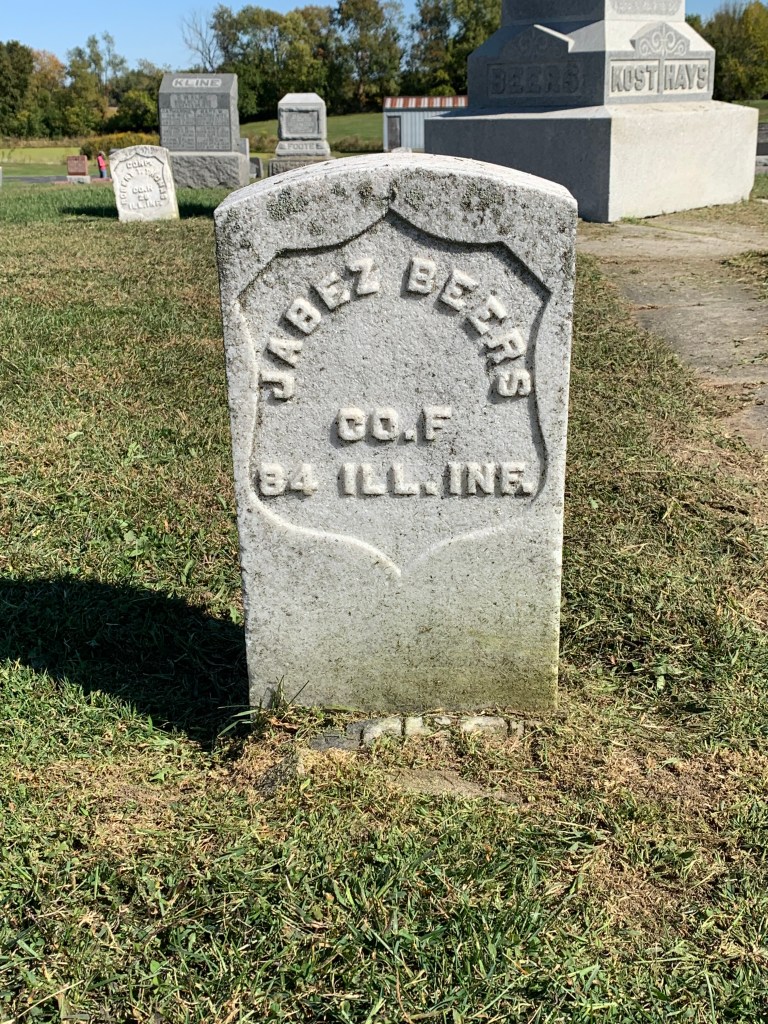
Jabez Beers, a farmer from Ipava, Illinois, played a significant role in the American Civil War as a soldier in the 84th Illinois Infantry, Company F. His military service is outlined as follows:
Jabez Beers, 27 years old and married at the time, enlisted on August 7, 1862. His enlistment papers describe him as a man of 5’10” in height, with brown hair, hazel eyes, and a fair complexion. He mustered into service at Quincy, Illinois, on September 1, 1862, marking the beginning of his military journey. On September 4th the citizens of Macomb, Illinois threw a big picnic party for the men of the 84th Illinois. People came from McDonough and Fulton counties to the area where the men were camping. Everyone enjoyed a good dinner with the men before they went into action. The day passed very happily but toward evening when it came time to part tears welled in many eyes as mothers, wives, daughters and sweethearts said goodbye, for some it would be the last time they saw their loved ones. (Simmons, History of the 84th Reg’t Ill. Vols. 1866)
The men were equipped with British Enfield rifles, knapsacks, haversacks and canteens fully ready for active service. On the 19th of September the soldiers of the 84th were paid their enlistment bonus of 25 dollars. Many left this money with their families for financial support. The 84th Illinois Infantry, known for its fighting spirit from the outset, departed Illinois for Louisville, Kentucky, on September 23, 1862, with a complement of 951 men. Among these soldiers, ready to serve his country was Jabez Beers. (Simmons, History of the 84th Reg’t Ill. Vols. 1866)
One of the most notable battles in which Jabez Beers and the 84th Illinois Infantry participated was the Battle of Stones River, which took place from December 31, 1862, to January 2 and 3, 1863, in Murfreesboro, Tennessee. During this intense engagement, the 84th Illinois suffered a significant loss of 228 men, highlighting the brutality of the conflict. The Battle of Stones River, by percentage of loss, stands as one of the bloodiest battle of the Civil War, with both Union and Confederate forces sustaining high casualties.
Following their participation at Stones River, the 84th Illinois Infantry continued to be actively involved in the war effort. On January 17, 1863, they fought at Woodbury. However, Private Jabez Beers faced challenges related to his health and was discharged because of a disability at Murfreesboro on March 4, 1863. He returned to Illinois, leaving behind the battlefield but carrying the memory of his service in the war.
It is worth noting that the 84th Illinois Infantry had a remarkable record of resilience and combat effectiveness throughout the Civil War, with only one man from the regiment being taken prisoner by the Confederates. Jabez Beers played his part in this storied unit’s history during a time of great upheaval and sacrifice in American history.
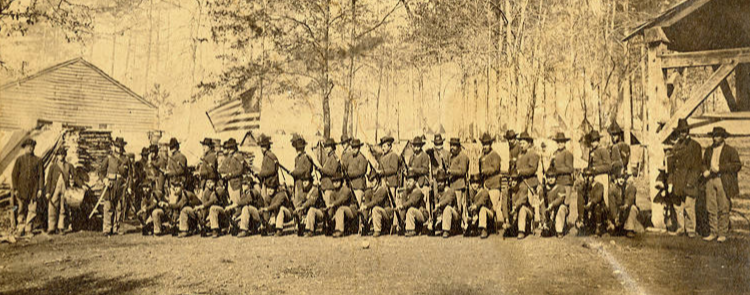
Jesse B. Scudder served in the 78th Illinois Infantry, Company I as a sergeant. He fought in more battles and served longer than any other family member during the Civil War. Jesse Scudder was the great, great grandfather of Conrad Landis Farr. Read the interesting story about Sergeant Scudder’s military service during the Civil War in the Our Stories section of this website.
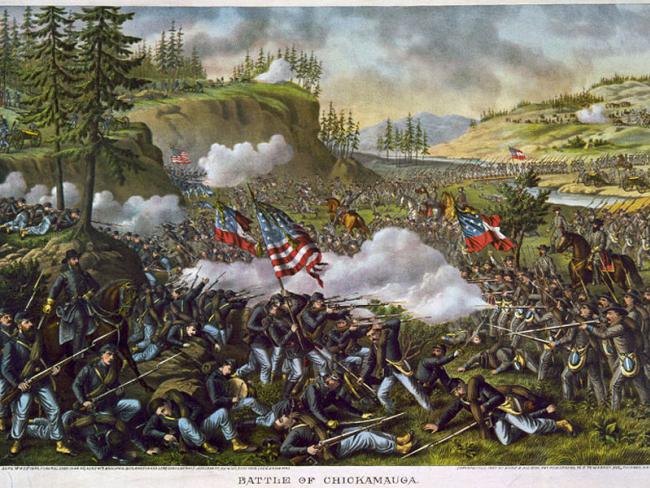
Martin Van Buren Scudder served as a Private in Company I of the 78th Illinois Infantry during the American Civil War. Notably, his brother, Jesse, also served alongside him as a Sergeant in the same company, highlighting the familial commitment to the Union cause.
Martin enlisted on August 11, 1862, demonstrating his dedication to the Union. Unfortunately, his military service was marked by challenges, as he was ultimately discharged from the army on June 30, 1863, due to a disability.
The 78th Illinois Infantry regiment, to which Martin belonged, played a role in various aspects of the Civil War. On September 19, 1862, the regiment received orders to move to Louisville, Kentucky. During their time in Louisville, they served as provost guard for a few days while General Buell was equipping his army after a notable race with Confederate General Bragg.
A significant incident during their service was the capture of companies B and C by Confederate guerrilla John Morgan on December 26. This capture occurred near Muldraugh’s Hill, in the vicinity of Elizabethtown. The soldiers of the 78th Illinois Infantry faced enemy fire from nine artillery pieces for approximately two hours during this encounter.
The first substantial engagement that the 78th Illinois Infantry participated in was at the Battle of Chickamauga, a significant battle in the Civil War. This highlights the regiment’s active involvement in the conflict and the challenging circumstances they faced.
Martin Van Buren Scudder’s service, like that of many others, reflects the hardships and sacrifices made during the Civil War, as well as the dedication to the Union cause by soldiers and their families.

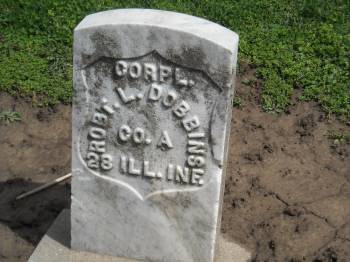
Robert L. Dobbins served as a Corporal in the 28th Illinois Infantry, Company H, during the American Civil War. He was a young man of 19 years when he answered the call to join the Union Army, enlisting on September 1, 1861, as a Private in the Illinois Infantry.
Throughout his service, Robert demonstrated dedication and ability, earning a promotion to the rank of Corporal. His military journey took him to various locations, including active participation in the campaign against the Confederates in Mobile, Alabama.
One of the most significant battles in which Robert Dobbins and the 28th Illinois Infantry participated was the Battle of Shiloh. This battle, fought in April 1862, was among the bloodiest encounters of the Civil War. Union forces under General Grant emerged victorious but sustained tremendous casualties, with over 13,000 soldiers affected. The battle took a heavy toll, with 1,754 killed, 8,408 wounded, and 2,885 missing or captured among the Union forces. Confederate casualties numbered 10,669.
Robert completed his initial three-year term of service in the army and chose to reenlist in Natchez, Mississippi, on February 15, 1864, committing to serve during the later stages of the war. He continued to serve until after the war’s conclusion, mustering out of the army on March 15, 1866, in Brownsville, Texas.
His enlistment papers describe him as being 5’7″ tall, with brown hair and black eyes. Robert L. Dobbins was born on November 22, 1842, in Ipava, Fulton County, Illinois. He was the son of John O. and Harriet (Miller) Dobbins. Robert died on 12 November 1919 in Lewistown, Illinois. Robert Dobbins is buried in the Ipava Cemetery, section 16, Fulton County, Illinois.
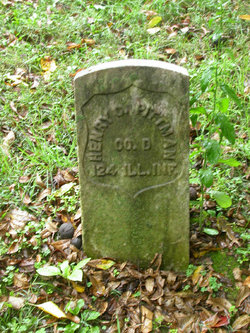
Henry Clay Pittman was born on July 3, 1843, in Industry, Illinois, to parents William Pittman and Nancy Wyatt. He hailed from a farming background, as noted in his enlistment records. Henry’s physical description is detailed in his enlistment papers, where he is described as being 5′ 7 3/4″ tall, with dark hair, blue eyes, and a fair complexion.
During the American Civil War, Henry answered the call to serve his country and enlisted in Company D of the 124th Illinois Regiment on October 27, 1863, in Mt. Sterling, Illinois. Subsequently, he was transferred to Company I of the 33rd Illinois Infantry Regiment.
Henry’s service in the Union Army was marked by dedication and sacrifice. Unfortunately, he faced the harsh reality of war, as he was discharged for disability due to disease on October 15, 1865, in Vicksburg, Mississippi.
One notable aspect of Henry Pittman’s service is that he served under the command of General Ulysses S. Grant during the Siege of Vicksburg. This siege was a pivotal and historic battle, involving a Union force of 75,000 troops against a Confederate force of 34,000 troops. The Siege of Vicksburg ultimately resulted in a Union victory.
After the war, Henry returned to civilian life. He remained unmarried and lived in Tennessee Township, Illinois. Sadly, he passed away on August 29, 1921, leaving behind a legacy of service to his country during a challenging and transformative period in American history. Henry Clay Pittman’s dedication to the Union cause is a testament to the courage and sacrifice of Civil War veterans.
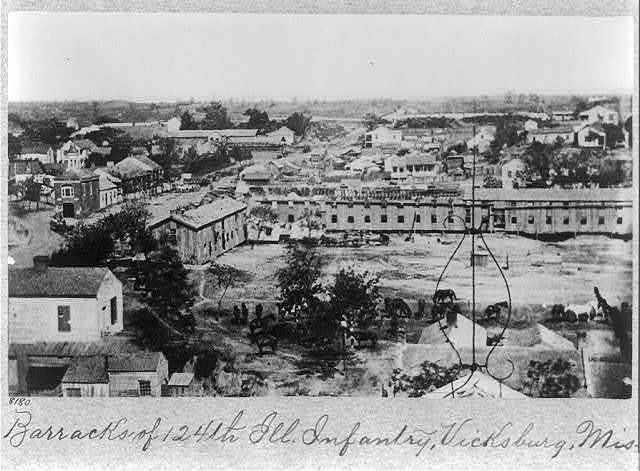
Burris E. Pittman served in the 78th Illinois Infantry, Company I as a private. On August 14th 1862, at the call of President Lincoln for 600,000 volunteers to suppress the rebellion in the south, Burris cast aside the plow, and volunteered for three years of service in the 78th Illinois Infantry. He served in the Defense of the Kentucky Railroads from 1862 to 1863. The hardships and privations of camp life, the long marches, with constant exposures took a toll on Burris. On October 4, 1863, he was mustered out of service on account of war related disabilities.
Burris E. Pittman was born in Todd County, Kentucky on September 2, 1826. He was the oldest of thirteen children of William and Nancy Wyatt Pittman. His parents moved to Morgan County, Illinois in 1828, and in the Fall of 1836, they moved to McDonough County, Illinois. At the age of 21, Burris married Julia Crisman, and purchased a farm two and a half miles south of Industry, Illinois. Burris sold his farm in 1867, and purchased a farm of three hundred and thirty-one acres, on Section 2, Lamoine Township, known as the David Jenkins farm, which was one of the best stock farms in the state at that time. Its location for stock purposes was excellent and the farm included a large brick house, large barn with numerous outbuildings, a well. There was also timber on the land he purchased. Burris had horses, cattle, a large number of hogs and a flock of sheep on his farm and the farm was a few miles from several stations on the Chicago, Burlington & Quincy Railroad which made shipping easy. Burris was also known to have natural artistic abilities. His drawings of homes and farms in McDonough County, Illinois were used in a book published about the people and history of the county. He died in 1902.
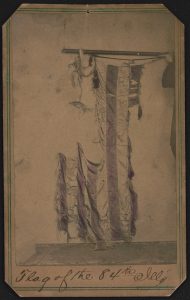
William Alexander Dobbins served as a Private in Company B of the 84th Illinois Infantry, proudly standing with his fellow soldiers to defend his country during the American Civil War. He was a part of the 84th Illinois Infantry, which engaged in various campaigns and battles during the war.
One of the most notable battles in which William Dobbins participated was the Battle of Chickamauga, which unfolded in Tennessee and northern Georgia under the leadership of General William Rosecrans. The battle, known for its intensity and duration, spanned three days and subjected the soldiers of the 84th Illinois to constant Confederate fire. During this battle, the 84th Illinois Infantry manned fortified positions to help defend against Confederate attacks.
The battle was marked by several Confederate charges, which ultimately led to the defeat of the Union forces, including the 84th Illinois Infantry. The regiment was part of Colonel Beatty’s brigade and was routed from the field on the third day of the battle. The Battle of Chickamauga resulted in a Confederate victory, forcing the Union army to withdraw to Chattanooga, Tennessee.
The 84th Illinois Infantry endured significant casualties during the battle, with 172 soldiers affected, one of whom was William Dobbins. He sustained a wound in his left forearm on September 19, 1863, during the fierce fighting at Chickamauga.
William’s injuries required him to be transferred to a hospital in Nashville for treatment. Tragically, he succumbed to his wounds on May 28, 1864, while at the Nashville General Hospital. His sacrifice and service to his country are honored, and his body was returned to Fulton County, where he was laid to rest in the family cemetery.
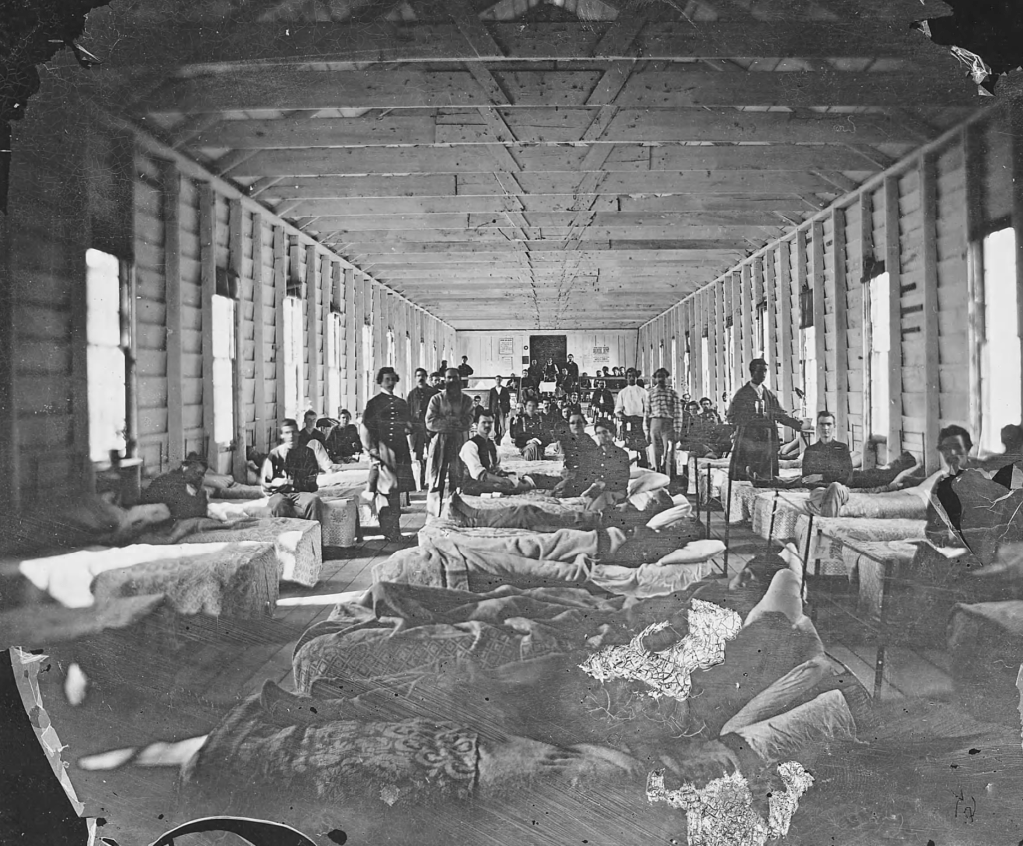
Civil War hospital picture taken by Matthew Brady.
William Alexander Dobbins‘s commitment to the Union cause and the ultimate price he paid are a testament to the valor and sacrifice of the soldiers who fought in the Civil War. His memory lives on as a reminder of the profound impact of the war on individuals and families across the nation.
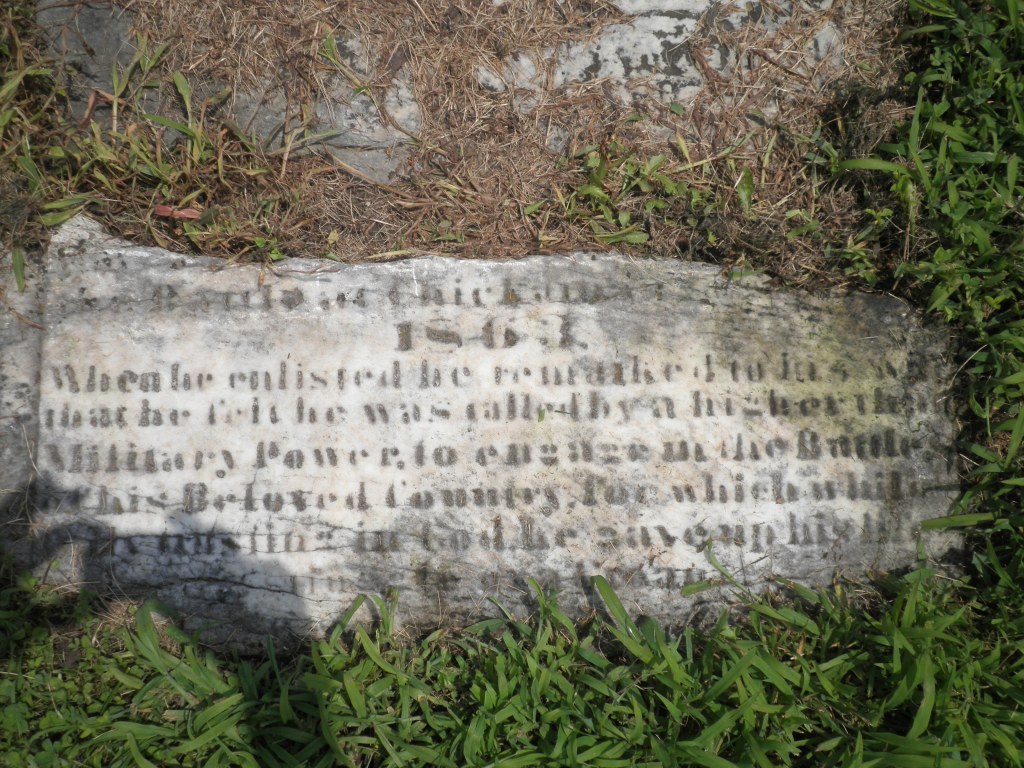

Benjamin Landis served in the 137th Illinois Infantry, Company K as a private. The 137th was assigned to guard and picket duty at Memphis, Tennessee until September of 1864. They repulsed Confederate General Forrest’s attack on Memphis on August 21, 1864. Benjamin Landis was mustered out September 4, 1864. Below headstone of Benjamin Landis in Oklahoma City. Benjamin Franklin Landis was born on October 10, 1849 in Jackson Township, Butler County, Pennsylvania. He died on February 7, 1935 in Oklahoma City, Oklahoma.

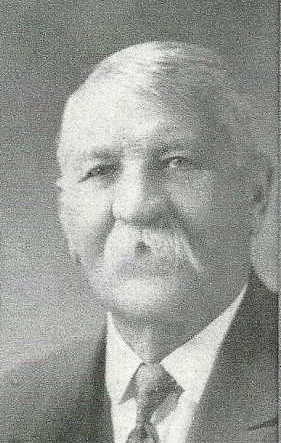
George Monroe Pittman served in 78th Illinois Infantry, Company I during the Civil War. See biography of George M. Pittman on this site for information about his service during the Civil War.
William A. Thomas, a farmer from Vermont Township, Fulton County, Illinois, enlisted as a private in Company F of the 84th Illinois Infantry on August 7, 1862, at the age of 24. Standing at 5 feet 8 1/2 inches tall, with brown hair, gray eyes, and a fair complexion, his records noted he was married. He served three years with the 84th Illinois seeing action in numerous battles such as: Battle of Chickamauga, Siege of Chattanooga, Battle of Lookout Mountain, Battle of Missionary Ridge, Battle of Kennesaw Mountain, the Siege of Atlanta and the Battle of Nashville. He was mustered in on September 1, 1862, in Quincy, Illinois, and served a full three-year term in the army. William was honorably mustered out on June 8, 1865, by Captain Morris upon the conclusion of the war.
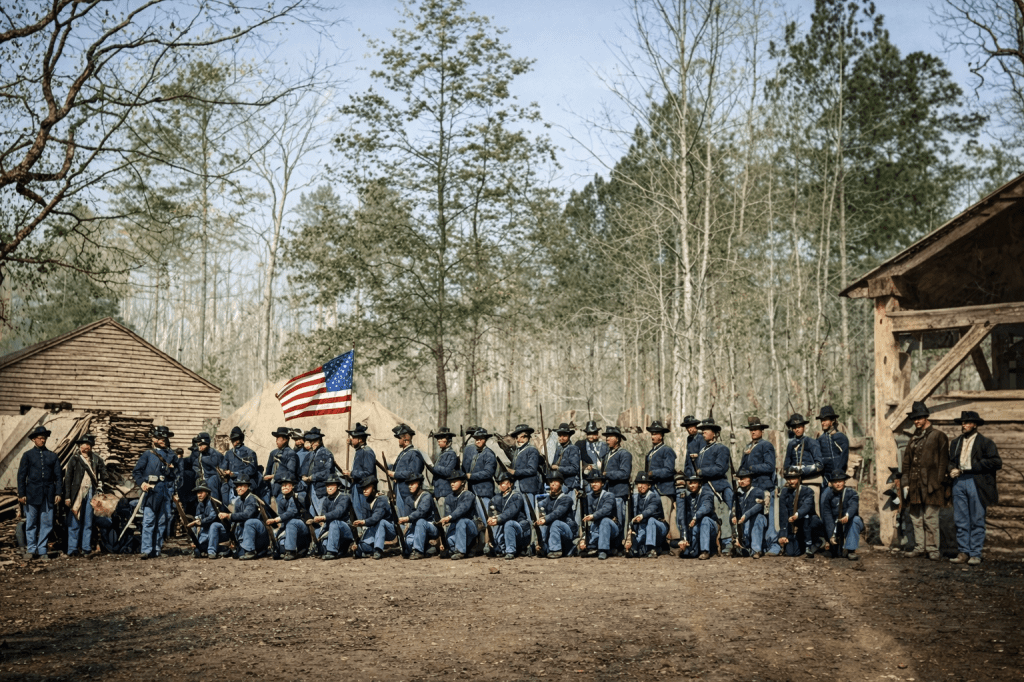
Joseph Predmore – Registered for the draft on July 1, 1863 in Illinois. He was born in 1827 and died in Barry, Illinois in 1898. He was a farmer.

Franklin Harvey Dobbins enlisted in Company H of the 28th Illinois Infantry on January 8, 1862, demonstrating his commitment to serve his country during the American Civil War. He was the son of John C. and Harriet Miller Dobbins and was born in Vermont Township, Fulton County, Illinois. At the time of his enlistment, Frank was a 23-year-old farmer.
His enlistment records provide a physical description of Frank, noting that he stood at 5’9 3/4” tall, had auburn-colored hair, blue eyes, and a light complexion. These details offer a glimpse into his appearance at the time of his service.
One of the significant battles in which Frank Dobbins and the 28th Illinois Infantry participated was the Battle of Hatchie’s Bridge, also known as the Battle of Metamora, which took place in Tennessee on October 5, 1862. During this engagement, Union forces, led by General Sterling Price, engaged Confederate forces and pushed them back for a distance of five miles to the Hatchie River. The 28th Illinois Infantry actively took part in this battle.
Frank Dobbins was seriously wounded during the Battle of Hatchie’s Bridge which is a somber reminder of the sacrifices made by soldiers during the American Civil War. Frank was wounded in the heat of battle, and sadly, died from his injuries.
The Battle of Hatchie’s Bridge was a brutal and costly engagement, resulting in significant casualties on both sides, with 500 Union soldiers killed and wounded, and 400 Confederate soldiers suffering the same fate, to underscore the severity of the battle.
Frank Dobbins’s cause of death, as recorded in army records, was a “gunshot wound” (vulnus sclopetarium), which tragically claimed his life. His service and sacrifice are honored and commemorated, with his final resting place in Corinth, Mississippi National Cemetery, Section B-212. Frank’s burial in a national cemetery is a testament to his dedication to his country and the price he paid in the line of duty during a tumultuous period in American history. His memory lives on as a reminder of the bravery and sacrifice of Civil War soldiers.
In his diary, George W. Reese of Co. H, 28th Illinois Infantry who served with Frank, described the Battle on the Hatchie River as follows: “The enemy had posted his artillery on the brow of the bluffs overlooking the Hatchie river near Davis’s bridge, but our determination overcome all obstacles. The infantry filled the forest and jungle. We carried the bridge at a charging step in the face of a deadly fire of grape and canister and Minnie balls, forcing the enemy across before us. Rebel batteries crowned the bluffs at a distance of 150 yards, commanding the bridge, the only crossing in that vicinity. Our brigade sustained a murderous fire at short range for one hour, during which time the 2nd Brigade crossed over and down the river and turned the enemy’s right flank. At 1 p.m., the enemy gave way and the rout became general, throwing away knapsacks and guns and abandoning their wagon trains.” George added that the boys later called this battle, “Hell on the Hatchie,” or Battle of Matamora. (Civil War Letters of William H.H. Kinsey Co. H 28th Illinois Infantry, WordPress.com)
John Spry served in the 103rd Illinois Infantry, Company F. He was the husband of Susanna Farr.
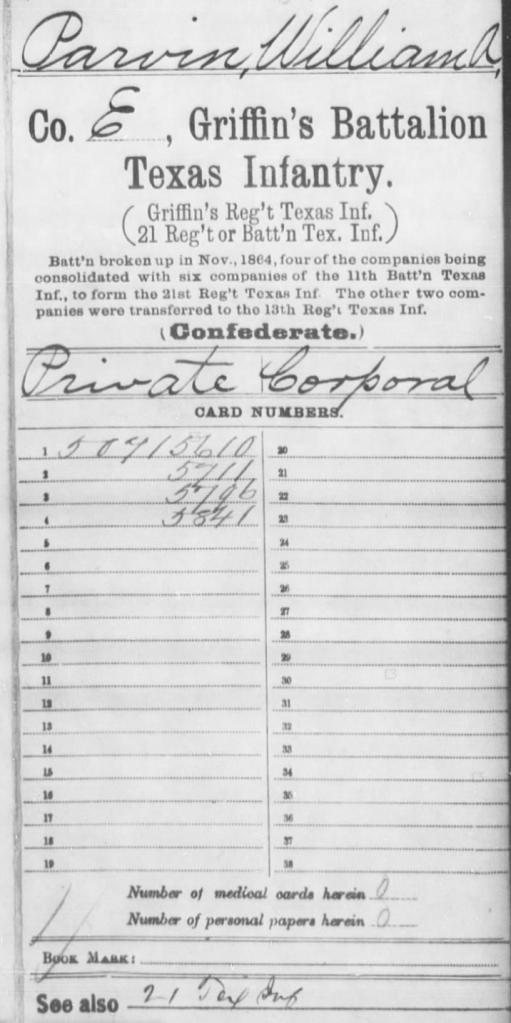
William A. Parvin stands as the sole relative of the Farr family to have served on the Confederate side during the Civil War. He was a member of Confederate Griffins Battalion, specifically Company E. Later, this battalion was incorporated into the 21st Regiment of Texas Infantry, another Confederate unit.

Griffins Battalion was organized in 1862, marking its early entry into the conflict. As the war progressed, the battalion was eventually restructured and divided. Four companies from the original battalion, designated as A, B, C, and E, were consolidated into the 11th Battalion Texas Infantry.
William A. Parvin’s service on the Confederate side during the Civil War reflects the complex and divided loyalties that characterized this period, as families and individuals found themselves on opposite sides of the conflict based on various factors, including geographic location and personal convictions. His choice to serve with the Confederacy in Texas during this turbulent time in American history is part of the broader narrative of the Civil War era.
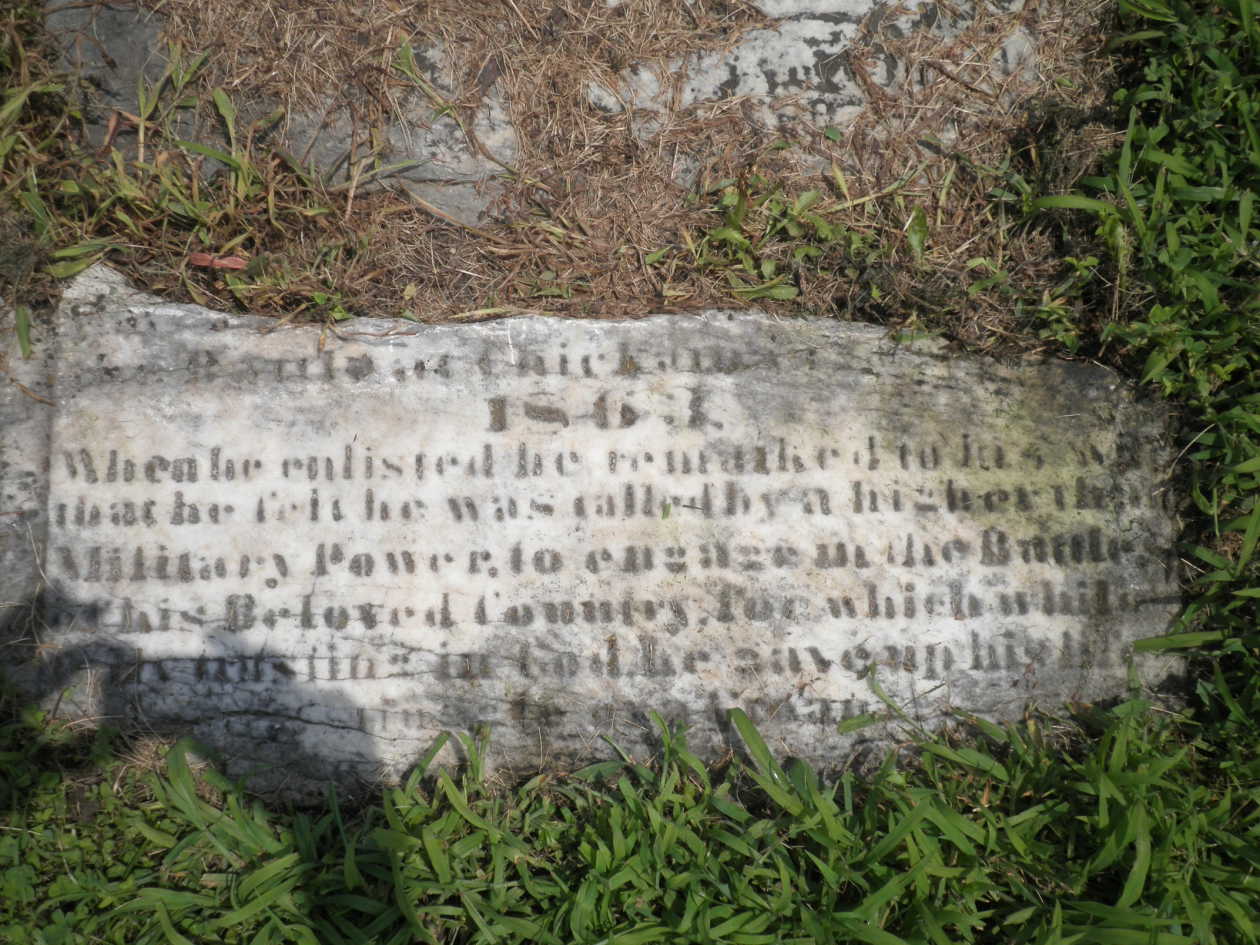
John Jackson Wyatt was born on August 20, 1817, in Christian, Kentucky, his father, John J. Wyatt, was 33 and his mother, Martha Thompson Wyatt, was 26 when he was born. He married Elizabeth Mayfield on April 24, 1834, in Pike County, Illinois. They had nine children in 15 years. John was a farmer and owned his own farm in Industry, Illinois which in 1860 was valued at $2000. John enlisted in the 62nd Illinois Infantry, Company I on April 10, 1862 and was mustered into service on the same date. He was 44 years old. He was commissioned a First Lieutenant. On June 20, 1863 he was promoted to Captain. The 62nd Illinois Infantry and Captain John Wyatt saw action in the following places during the Civil War. They fought against Confederates led by General Forest in West Tennessee from December 18, 1862 to January 3, 1863. Then they saw action at Salem Cemetery, near Jackson, Mississippi on December 19, 1862. They were a Holly Springs, Miss. and at Jackson, Tennessee till April 18, 1863. Then the 62nd Infantry moved to LaGrange, Tennessee on April 18, and had duty there until August 1863. They then moved to Memphis, Tennessee, and on to Helena, Arkansas from August 19-28. The 62nd fought in General Steele’s Campaign against Confederates in Little Rock, Arkansas from August 28 to September 10 capturing Little Rock. They were on duty at Little Rock until April 25, 1864.
John resigned his Commission on August 5, 1864 and was mustered out of service on that date and returned to Industry. He died a little over a year later on September 6, 1865, in Industry, Illinois, at the age of 48, and was buried at the Standard Cemetery just south of Industry.
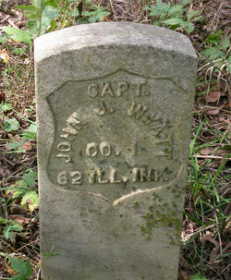
John Jackson Wyatt’s tombstone in the Standard Cemetery just south of Industry, Illinois.
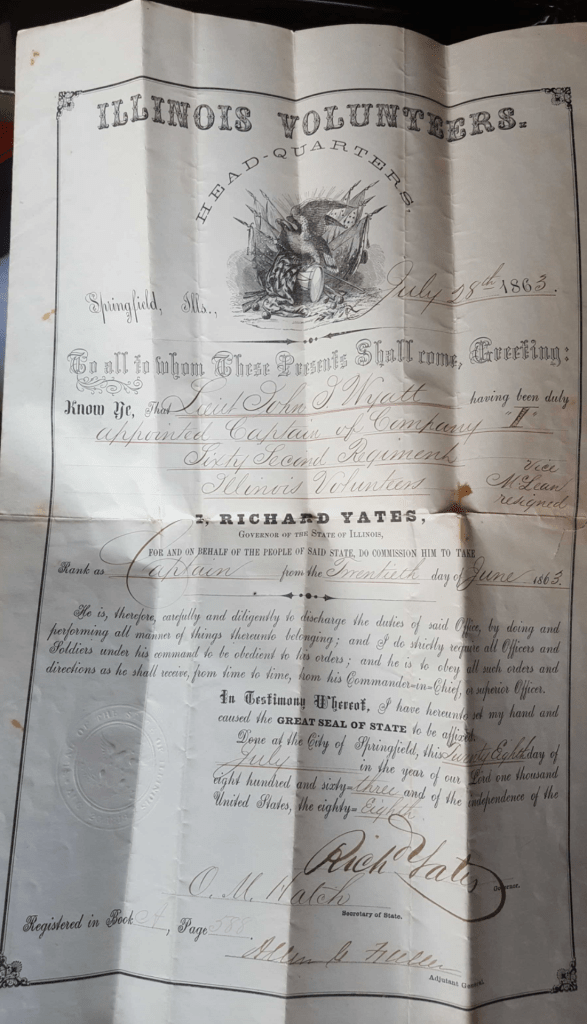
John Wyatt’s Commission Papers to Captain from Illinois Governor Richard Yates in 1863.
Daniel Webster Wyatt was born in 1845 in Industry, McDonough County, Illinois. His parents were John Jackson Wyatt and Elizabeth Mayfield Wyatt. Daniel grew up on his parents farm in Industry, Illinois and in the 1860 U.S. Census he is listed as being a farmer just like his father. Daniel enlisted in the 62nd Illinois Volunteer Infantry, Company I at Mt. Sterling, Illinois on December 29, 1863 as a private. His father John Wyatt was a captain serving in the same company. Daniel Wyatt was 18 years old when he enlisted, had red hair, blue eyes and a florid complexion according to his enlistment record. He died from disease which he contracted in the line of duty according to the Army, on February 25, 1864 at Little Rock, Arkansas, with his father at his side. The following are journal entries written by Captain John Wyatt about the sickness and death of Daniel, while the two were serving in the Union Army in Little Rock during the Civil War.
February 16, Tuesday: Son Daniel taken sick and I was relieved from the court marshal and returned to my company.
February 17, Wednesday: Numonia (sic) develops itself with a good deal of malignance. Stayed with him nearly all day.
February 18, Thursday: This day the symptoms are decidedly better. I am officer of the day and absent nearly all day but find my son better at night.
February 19, Friday: This day visit my son as often as possible. He still seems better. Stay with him till after midnight.
February 20, Saturday: My son seems to linger about one thing. Begin to feel uneasy about him. Don’t like his symptoms.
February 21, Sunday: This morning the hopes of all revive and we think Daniel will get up all right in a few days.
February 22, Monday: This day my faith fails entirely in my son’s recovery. Feel very much cast down. Can’t go near his bed. Sick.
February 23, Tuesday: This day he has come to his right mind. I talk to him about death. He begins to pray. Attends to nothing else during the day.
February 24, Wednesday: This morning he is calm and serene, but the fever unabated. He sings, shouts, laughs and says tell another it is all right.
February 25, Thursday: This morning at 5 o’clock he passed away without a sigh to the spirit land. At 4 o’clock I am enroute for home with his remains.
Captain John Wyatt took his son Private Daniel Wyatt home to Industry, Illinois to be buried. On March 3, 1864, John arrived in Macomb, Illinois, the county seat, and got a hearse to take his son home. Industry is about fifteen miles away from Macomb and they arrived there around 1:00 p.m. He writes that he greeted his wife Elizabeth and what a sad meeting it was. The next day John says it snowed quite a bit, but he oversaw the digging of Daniel’s grave. The funeral and burial were on Saturday, March 5th. John wrote that the sun came out and it was warm. Daniel was buried with full military honors which John said was “one of the most imposing scenes it has ever been my privilege to see.” Fifteen hundred persons were in attendance at the funeral. Industry only had a population of about 600 people, Macomb had a much larger population, so people turned out from all over McDonough and Fulton Counties. The large turn out is a testament to the respect that local citizens had for the sacrifice that Daniel made on behalf of the country.

Diary that Captain John Wyatt kept during the Civil War
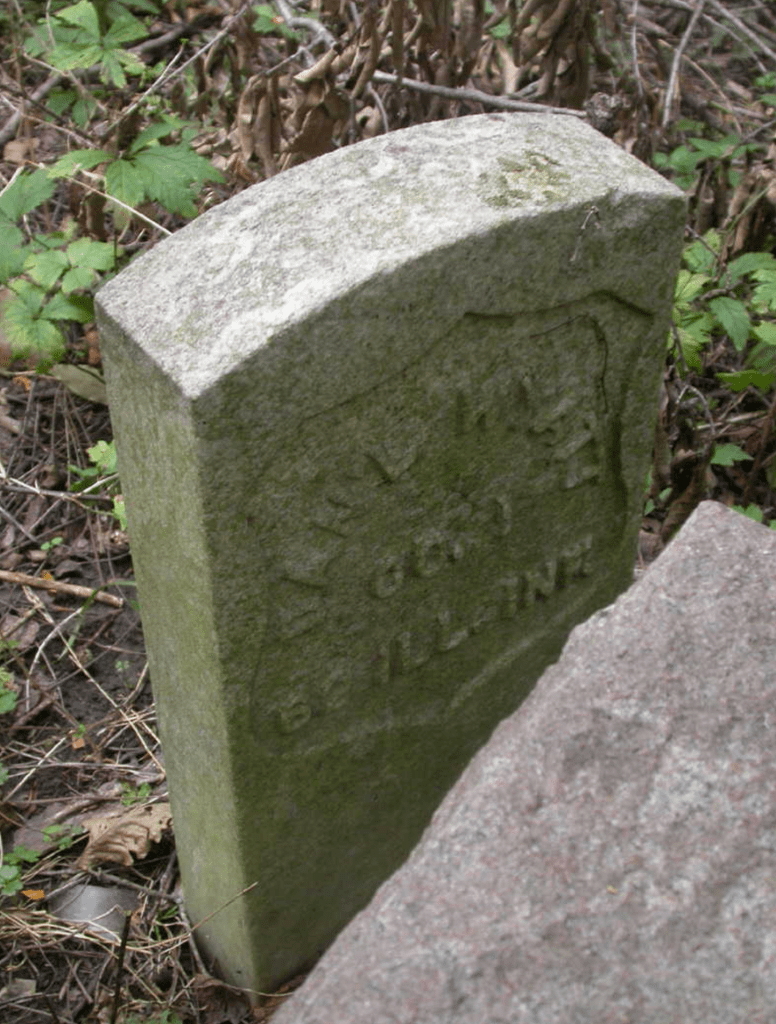
Daniel Wyatt’s tombstone in the Standard Cemetery south of Industry, Illinois.
 Farr's of Fulton County, Illinois